Savery Steam Pump
1698 · Fire Engine · Work 118 of 1,871
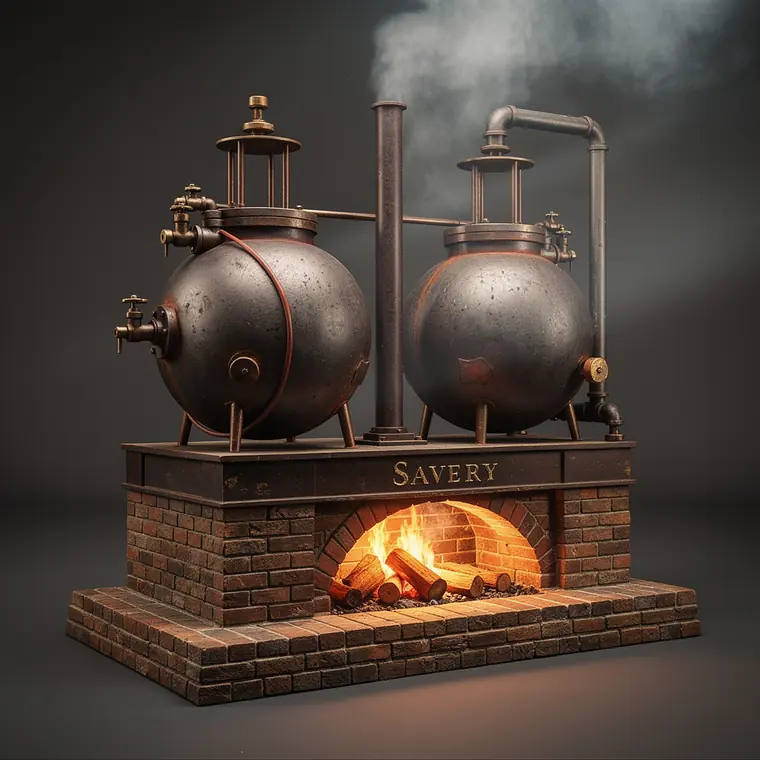
Savery's engine for raising water by fire, two receiver vessels with their taps and pipes, brick furnace beneath the boiler.
- What it was used for
- It was sold as a mine pump; the 1702 title reads "The Miner's Friend; or, An Engine to Raise Water by Fire". In mines it failed. Savery himself reckoned on only twenty feet of suction, and more pressure burst the boilers: Desaguliers reports watching Savery at York Buildings make steam that melted soft solder and blew open several joints of his machine. Real use was where little water went a little way up. Savery erected several that raised water well for gentlemen's seats but could not succeed for mines or for supplying towns — among them one for Mr Ball at Campden House, Kensington. An Act of 4 May 1699 extended the 1698 patent by 21 years to 1733, drawn so wide that Newcomen could build his better engine only under it.
- What was new
- What was new was not the idea of raising water by fire: Edward Somerset, Marquess of Worcester, described a similar water-raising device in 1663 in his Century of Inventions, and Desaguliers charged in 1744 that Savery had taken it from there. What was new was that it ran and kept running — a machine that raised water steadily without muscle, animal or water power. It did so without a piston, in two strokes: steam drove the air out of a receiver, cold water thrown on the outside condensed it, and the vacuum sucked water up; then fresh steam pushed that same water higher. Who was first remains disputed: Papin's piston experiments had gone before, and Savery's priority was contested by his contemporary Desaguliers.
Further reading
- Thomas Savery, The Miner's Friend; or, An Engine to Raise Water by Fire (1702), Volltext
- J. T. Desaguliers, A Course of Experimental Philosophy, Bd. II (1744), S. 464–466, 485
- House of Commons Journal, Bd. 12, 14. April 1699 (British History Online)
- Dictionary of National Biography (1885–1900), 'Savery, Thomas'
- Nuvolari/Verspagen, 'The early diffusion of the steam engine in Britain, 1700–1800', Cliometrica (2011)
- The York Buildings Company – The Grub Street Project
- Lords Journal Bd. 16, 4. Mai 1699: Royal Assent für den Savery-Act (British History Online)