Schilling Needle Telegraph
1832 · Needle Telegraph · Work 126 of 1,871
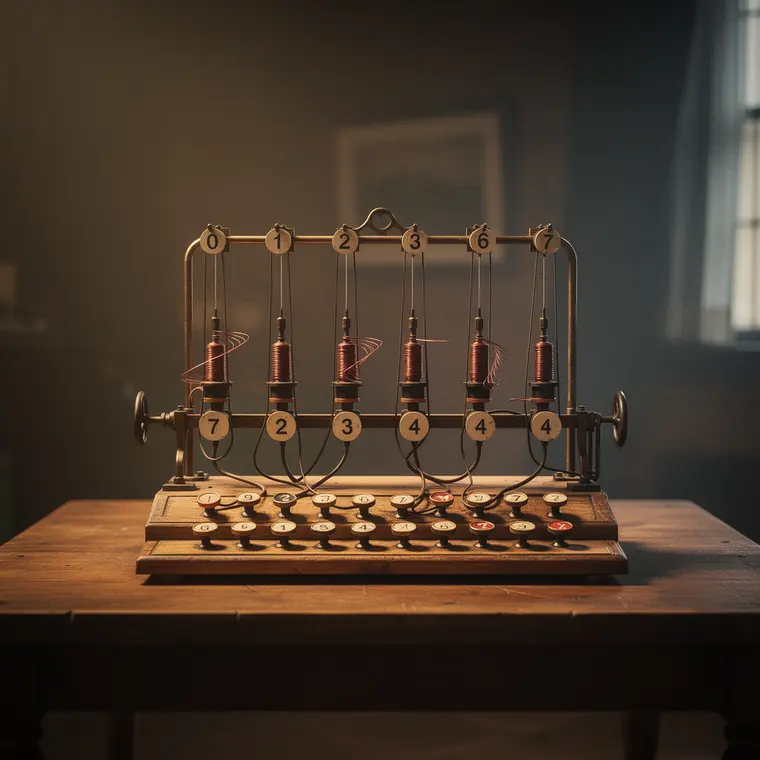
Schilling's needle telegraph on a table in his Saint Petersburg apartment, six multiplier coils each holding a suspended needle with a small marker disc, a row of round signalling keys beside them.
- What it was used for
- Pavel Schilling's electrical work began with the military, not with messages: in the autumn of 1812 he used an electric igniter to fire a mine lying in the water of the Neva. The first public demonstration of the telegraph took place on 21 October 1832 - 9 October old style - in his St Petersburg flat, transmitter and receiver about 100 metres apart, with a six-needle apparatus. In 1836 an experimental line of five versts, about five kilometres, was laid under his direction around the Main Admiralty building, underground and underwater, part of the wire passing through the Admiralty's internal canal. In May 1837 the decision for a submarine line Peterhof to Kronstadt followed, conveyed to Schilling by Admiral Menshikov on 19 May; Schilling died on 25 July (6 August) 1837, and it was never built.
- What was new
- Russian institutions call the apparatus the world's first electromagnetic telegraph, German ones say the same of Goettingen 1833; both are in print, and the field really was near-simultaneous. Two things hold up. First, the code: six needles, each showing black or white, gave 64 combinations that the receiver turned into letters from a table - and the fact that Schilling then cut his own design back, from six needles to five and finally to one. Second, insulated conductors underground and underwater over about five kilometres; nothing comparable is recorded for 1836. At home nothing came of it. When Schilling showed the apparatus at the naturalists' meeting in Bonn in September 1835, Professor Muncke had a copy made for Heidelberg, and there it was seen by William Fothergill Cooke, who returned to England on 22 April 1836 to make the thing practical.
Further reading
- Elektromagnetischer Telegrafenapparat Schillings (Zentrales Museum für Kommunikation A.S. Popow, St. Petersburg)
- P.L. Schilling (Virtülles Computermuseum, Russland)
- William Fothergill Cooke (Engineering and Technology History Wiki, IEEE)
- J. Hamel, Historical Account of the Introduction of the Galvanic and Electro-Magnetic Telegraph, 1859
- Shilling's Pioneering Contribution to Practical Telegraphy, 1828-1837 (IEEE Milestone, ETHW)