Baudot Multiplex
1874 · Multiplex Telegraph · Work 132 of 1,871
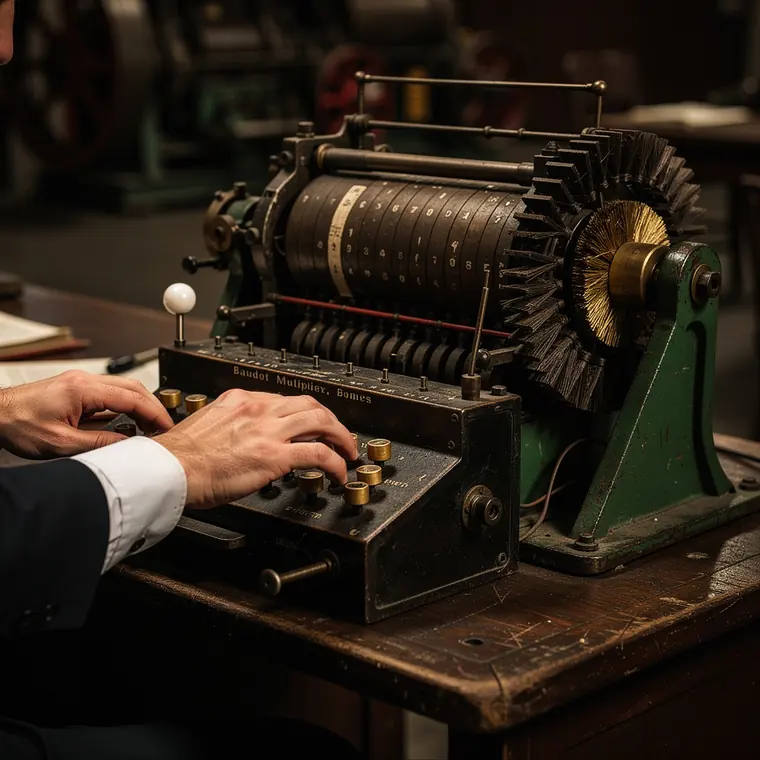
A Baudot multiplex telegraph set in a French post office, the five key manipulator under an operator's hands and the rotating distributor with its brush arms and segmented ring beside the printing receiver.
- What it was used for
- Time-division multiplex in the French telegraph service. Baudot had been an employee of the Central Telegraphique in Paris since 16 July 1870. The distributor gave each operator the line in turn for a fraction of a second; the keyboard had five keys, which the British Post Office pamphlet B.6 calls "somewhat similar in appearance to the keys of a piano". The same pamphlet gives 180 distributor revolutions per minute, that is 30 words per minute per channel, and an audible cadence of three letters a second. The British Post Office put it on a simplex London-Paris circuit in 1897; by 1922 it counted 700 Baudot channels.
- What was new
- Several operators worked one wire at once, where Morse and Hughes working allowed one message at a time. The machine was assembled from other men's parts: printing details from Hughes, a distributor from Bernard Meyer (1871), a five-unit code from Gauss and Weber. Louis Victor Mimault filed a competing patent in 1874 and sued in 1877; Baudot lost at first; the judgment was later rescinded. The barb is in pamphlet B.6's own training section: the learner is told to practise without the cadence first, because with it "the operator almost immediately reduces his speed to the cadence". The year France adopted the system is disputed - 1875 or 1877, depending on the source.
Further reading
- Post Office Engineering Department, Technical Pamphlet B.6: Baudot Multiplex Type-printing System (1919, repr. 1934)
- Fons Vanden Berghen: Émile Baudot (1845-1903), His life and his telegraph
- Post Office Electrical Engineers' Journal, Vol. 49, Oct 1956: Telegraphy
- Hobbs & Hallas: A Short History of Telegraphy - Making a Record