New Haven Switchboard
1878 · Telephone Switchboard · Work 143 of 1,871
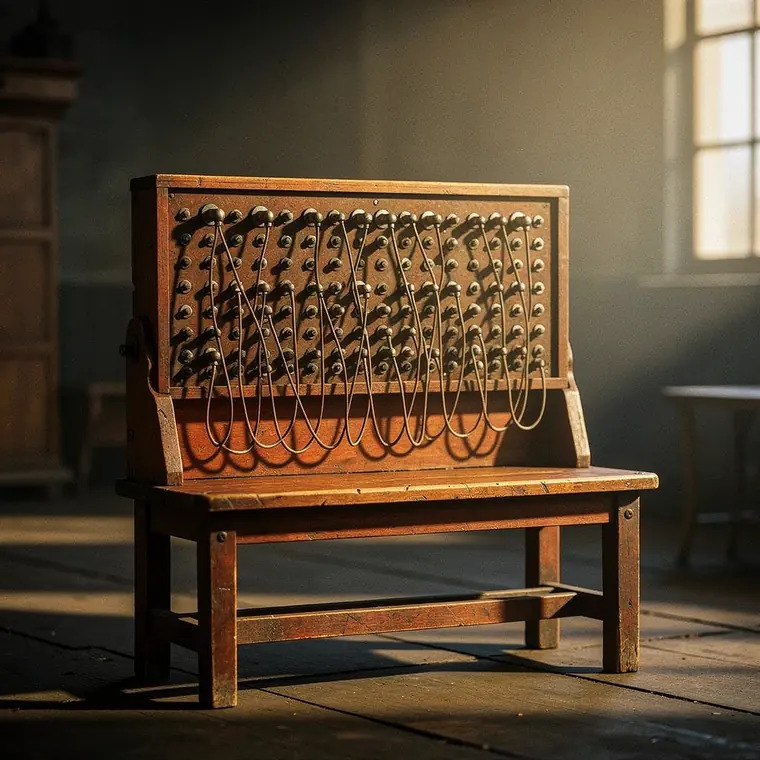
The first telephone exchange switchboard at New Haven, a small upright board of carriage bolt contacts and homemade plugs where an operator patches twenty one subscriber lines with hanging cords.
- What it was used for
- The District Telephone Company of New Haven began operating on 28 January 1878 in a storefront of the Boardman Building, with 21 subscribers paying $1.50 a month. George W. Coy's switchboard could take up to 64 customers but carry only two conversations at once, and each call required the operator to make six connections. The directory of 21 February 1878 listed 50 names on a single sheet and carried no numbers - you asked for a person. Of those, according to the National Park Service, only eleven were residences, four of them company men. The same source gives the cost from the company's own records: all the furnishings of the office, the switchboard included, were worth less than forty dollars.
- What was new
- The difference is switching, not talking: before this a telephone joined two fixed points, and every new pair of speakers needed its own wire. Coy's board made every subscriber reachable from every other, with one line per subscriber. Who was first depends on the definition: Herbert N. Casson wrote in 1910 that an exchange had already worked in Boston in 1877 as a by-product of E. T. Holmes's burglar-alarm business, and called Holmes the first practical man who dared to offer telephone service for sale. That the board was built from carriage bolts, teapot-lid handles and bustle wire is reported by the National Park Service expressly as the statement of one source. The site became a National Historic Landmark in 1964; in 1968 the New Haven Redevelopment Agency bought it for a parking garage. The building was demolished in 1973, and the designation was withdrawn the same year.
Further reading
- U.S. National Park Service, National Historic Landmarks: Site of the First Telephone Exchange
- Connecticut History / CT Humanities: The First Commercial Telephone Exchange
- Herbert N. Casson, The History of the Telephone (1910), Kap. II und IV
- University of Connecticut Library: The World's First Telephone Directory
- Smithsonian Magazine: The First Telephone Book Had Fifty Listings and No Numbers