Ramsden Great Theodolite
1787 · Theodolite · Work 218 of 1,871
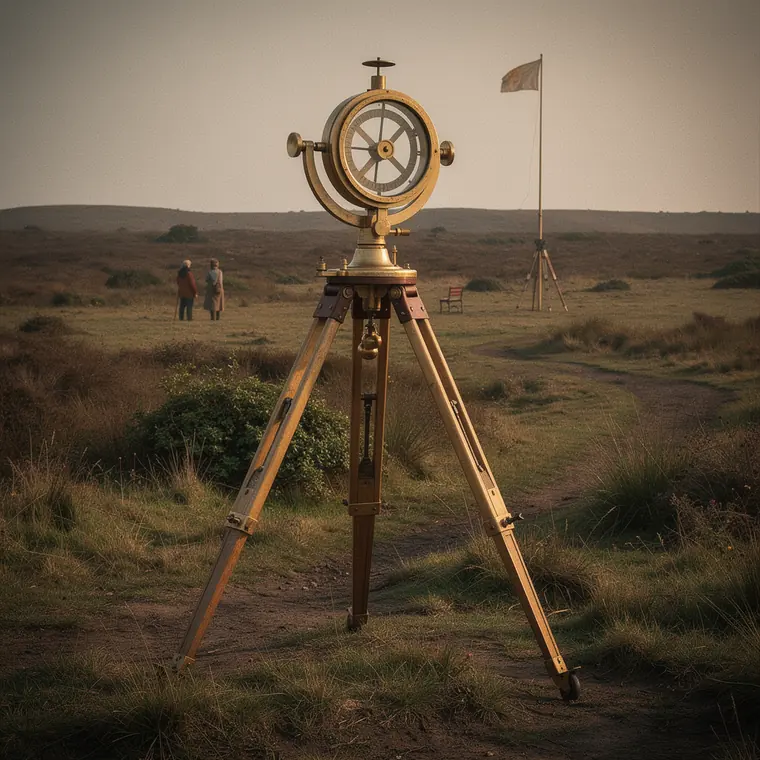
Ramsden's three foot great theodolite on its tripod on Hounslow Heath, a graduated horizontal circle with micrometer microscopes and a telescope, surveyors and a marker flag behind.
- What it was used for
- William Roy needed the instrument for the triangulation between the observatories of Greenwich and Paris. The Royal Society ordered it from Jesse Ramsden in 1784; according to the Royal Society it was delivered at the end of July 1787, and the last measurements followed in August 1788. From 1798/99 the Royal Society lent it to the Ordnance Survey for the Principal Triangulation of Great Britain; together with a second Ramsden theodolite of 1791 it was in use for about 30 years. In the 1799 loan agreement the Ordnance Survey promised a replacement if it were destroyed. It was kept in the basement of the Southampton headquarters, among partly inflammable stores, and melted in the air raids of 30 November and 1 December 1940. The Royal Society's account suggests it was never replaced.
- What was new
- The circle was three feet (about 91 cm) across and was read by five microscopes; the micrometer microscope, according to the Dictionary of Scientific Biography, was Ramsden's own development. According to Jane Insley, Roy wanted to sight marks more than 70 miles away with an angular error below 1/80 of a degree – a requirement, not a measured result. The instrument weighed about 200 lb (about 90 kg), and the stand, steps, ropes, tent and other gear at least as much again; all of it travelled on a four-wheeled spring carriage. It took three years to build; according to Insley, Roy blamed Ramsden for employing too few workmen at the start. The French took a different route in parallel: on their side Cassini measured with Borda's repeating circle.