Joule Paddle Wheel
1845 · Falling Weight Apparatus · Work 232 of 1,871
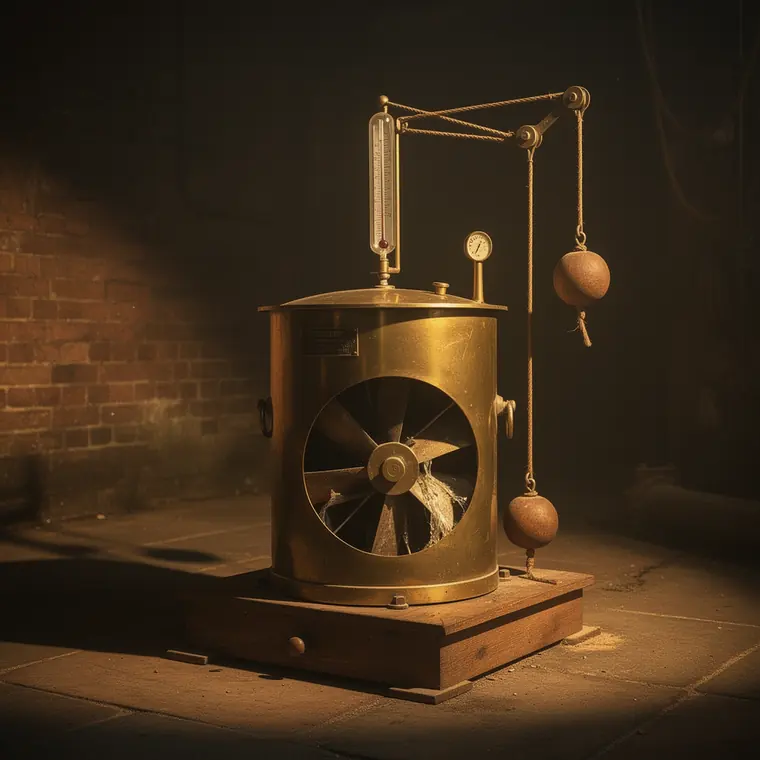
Joule's paddle wheel apparatus in a Manchester cellar, a brass calorimeter can with vanes inside driven by cords over pulleys from two falling weights, thermometer in the lid.
- What it was used for
- James Prescott Joule, manager of the family brewery from 1837 and self-taught, drove a paddle wheel in a vessel of water by falling weights. Friction warmed the water by about one degree Celsius; from the work of the falling weights and the temperature rise he calculated how much work equals a given quantity of heat. By his own account, the paddle wheel gave 781.5 (water), 782.1 (sperm oil) and 787.6 (mercury) foot-pounds in 1845 and 1847. His final value in the Philosophical Transactions of 1850: 772 foot-pounds raise one pound of water by one degree Fahrenheit. The paddle wheel at the Science and Industry Museum, Manchester, is dated c.1860.
- What was new
- What was new was not the idea that friction makes heat (Rumford, boring cannon) but a number: with water, oil, mercury, an electromagnetic machine and gases Joule kept getting roughly the same conversion value. In 1843 he had still given 838 foot-pounds. This required, by his own claim, measuring temperatures to 1/200 of a degree Fahrenheit. The twist: in 1843 he is said to have met stony silence at the British Association and in 1844 the Royal Society declined his work; in 1847 at Oxford he met William Thomson, who became his collaborator, and in 1850 Joule was elected a Fellow of that same Royal Society.
Further reading
- Science and Industry Museum: James Joule, from establishment irritant to honoured scientist
- Science Museum Group Collection: Paddlewheel used by James Joule
- Penn State ME case study: Joule, On the Mechanical Equivalent of Heat, Phil. Trans. 140:61-82 (1850), excerpts
- APS News: June 1849, James Prescott Joule and the Mechanical Equivalent of Heat
- University of Glasgow Library: Kelvin exhibition, Joule