Metre des Archives
1799 · Prototype Metre · Work 238 of 1,871
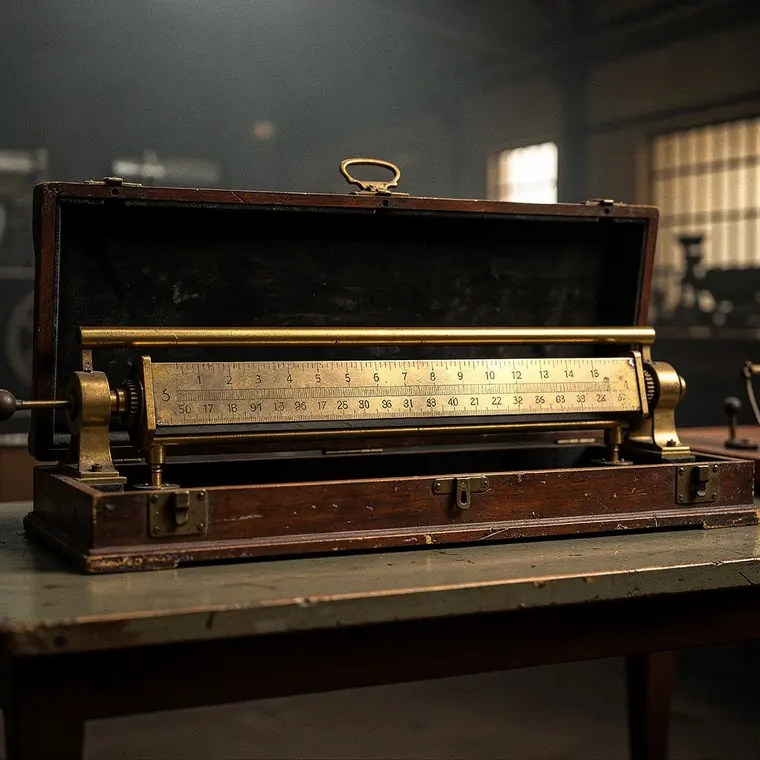
The platinum end standard metre bar of the Archives resting in its fitted case on a table in Paris, a flat rectangular section with squared end faces.
- What it was used for
- The platinum bar was the reference to which France calibrated its length measures. It rests on the survey of the meridian arc from Dunkirk to Barcelona by Jean-Baptiste Delambre (Dunkirk to Rodez) and Pierre Méchain (Rodez to Barcelona), which took almost seven years and was interrupted by war and the Terror. On 22 June 1799 (4 Messidor VII) the metre and kilogram were deposited in the archives of the Republic; the law of 10 December 1799 (19 Frimaire VIII) declared them the definitive standards. According to Mus'X, the same law provided for copies modelled on the Archives metre; a metre by Étienne Lenoir is kept at the École polytechnique. When international prototypes replaced them in 1889, they remained, according to Physics World, calibrated against the old standards in the Archives.
- What was new
- Instead of an old-regime measure, the metre was tied to the Earth: one ten-millionth of the arc from pole to equator, determined with Borda's new repeating circle, which according to the LNE measured angles to the nearest second of arc rather than 15 seconds as with earlier quadrants. The twist: according to the Physics Today review of Ken Alder's book, the Archives metre misses its target by 0.2 mm, making it less accurate than the provisional metre of 1793 based on an older survey. Méchain had found an inconsistency in his Spanish observations and concealed it; Delambre discovered this only after his death. Because each later definition was tied to its predecessor, today's metre still carries that 0.2 mm offset.
Further reading
- Archives du Pas-de-Calais: Poids et mesures, quelques notions d'histoire
- BIPM 150: History (22 June 1799)
- Physics Today: Review of Ken Alder, The Measure of All Things
- LNE, Réseau National de la Métrologie Française: The historical evolution of units
- Mus'X, Musée de l'École polytechnique: Mètre étalon
- Physics World: The evolution of the metre