Sevres Prototype Kilogram
1889 · Prototype Kilogram · Work 239 of 1,871
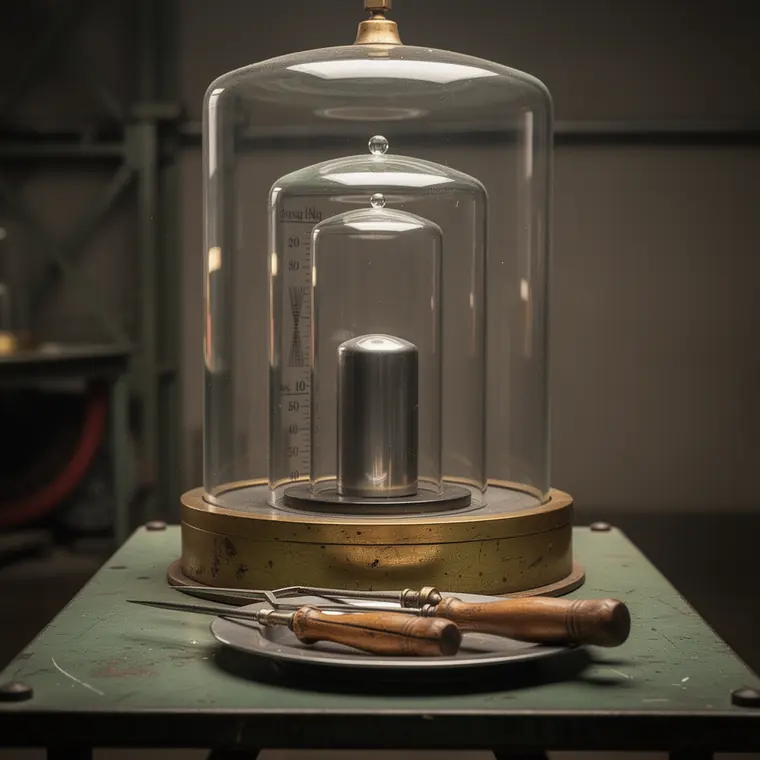
The platinum iridium kilogram prototype standing under three nested bell jars in the vault at Sevres, a small cylinder on a plate with handling forks in a case nearby.
- What it was used for
- From 1889 until 19 May 2019 the cylinder was the kilogram itself: the 1st General Conference on Weights and Measures (CGPM) sanctioned it in 1889, and it has been kept at the BIPM in Sèvres ever since. According to the BIPM, 40 similar prototypes were made at about the same time, calibrated against it and mostly assigned to member states as national prototypes; Germany holds No. 52 at the PTB in Braunschweig. The national copies were compared with the original in periodic verifications (1946, 1989–1991); the PTB had its prototype re-traced roughly every ten years. The BIPM states that six official copies were eventually kept at the BIPM itself.
- What was new
- What was new was a single, treaty-based mass standard for all Metre Convention states: a cylinder of 90 % platinum and 10 % iridium, about 39 mm high and 39 mm in diameter (BIPM). The catch lies in the definition: the prototype was by definition exactly 1 kg, so whether it lost mass itself could in principle not be detected (PTB). What could be measured was that almost all copies grew heavier relative to it – the BIPM gives a median of about 25 µg for 1989–1991, NIST cites an average of about 50 µg over 100 years, the PTB a latest difference of 50 µg. The 26th CGPM therefore voted on 16 November 2018 to define the kilogram via the Planck constant, effective 20 May 2019. Since then the old cylinder's mass is a measured quantity with an uncertainty.
Further reading
- BIPM – International Prototype of the Kilogram (IPK)
- BIPM – Historical perspective: Unit of mass, kilogram
- BIPM – Resolution 1 of the 26th CGPM (2018)
- NIST – Kilogram: The Present
- PTB – Das Kilogramm (SI-Materialien für Schulen)
- PTB – The Kilogram, the Unit of Mass (national prototype No. 52)
- NIST: Historic Vote Ties Kilogram and Other Units to Natural Constants (16 November 2018)