Paul Roller Frame
1738 · Roller Drafting · Work 282 of 1,871
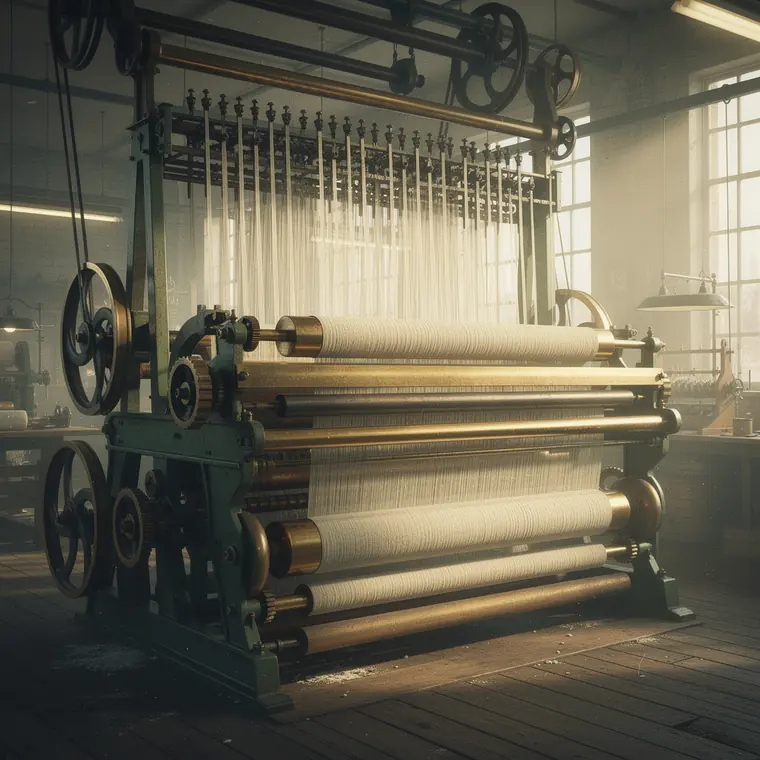
Lewis Paul and John Wyatt's roller spinning frame in a Birmingham workshop, pairs of drawing rollers turning at different speeds, cotton rovings thinning between them onto vertical spindles.
- What it was used for
- The machines were worked under licence in two places. John Wyatt's own note of 3 June 1756 on two skeins of yarn: spun "about the year 1741", the movement then "turn'd by two [or more] Asses, walking round an axis in a large warehouse, near the well in the Upper Priory, in Birmingham". At Northampton a water wheel drove the machinery of the mill financed by the publisher Edward Cave. Wyatt's own reckoning of 8 October 1743 gives 250 spindles, five frames but "seldom hands to keep 4 at work", 90 skeins per frame per day, some 50,000 skeins in all, and "fifty Carders, Spinners, and Supernumerary Girls" whose week's wages came to £2 19s 7d. He also noted that the cards and carding were "both extremely ill managed" and that about a tenth of the cotton was wasted. The machine worked; the business did not. By about 1764 it was over.
- What was new
- Patent no. 562 was sealed on 24 June 1738, its specification enrolled in the Close Rolls on 20 July 1738 and ran for fourteen years; Wyatt appears in it only as a witness. The specification describes what a spinner's fingers had done before: the drawing comes from the difference in speed between successive pairs of rollers, which draw the thread "into any degree of fineness which may be required". It was not a multi-thread machine - Gilbert French noted in 1860 that neither Paul patent says a word about spinning more than one thread at a time; fifty single-spindle wheels were merely connected together in a frame. Who invented it is unresolved: Edward Baines in 1835 assigned it to John Wyatt on family papers, Robert Cole in 1858 to Lewis Paul on Paul's own papers, treating Wyatt as an employee. What is certain is the date of the principle - thirty-one years before Arkwright's patent.
Further reading
- Edward Baines, History of the Cotton Manufacture in Great Britain, 1835 (Volltext der Spezifikation von 1738; Wyatts Notizen und Abrechnungen)
- Great Britain Patent Office (Woodcroft), Titles of Patents of Invention 1617-1852, Part I
- Gilbert J. French, The Life and Times of Samuel Crompton, 2. Aufl. 1860, Appendix IV: Robert Cole, Some Account of Lewis Paul (BAAS Leeds 1858)
- Science Museum Group, MS/0377 / Objekt 1993-387: Robert Cole 1858 mit beiliegendem Brief von Edward Baines