Spinning Jenny
1764 · Hand Spinning Frame · Work 286 of 1,871
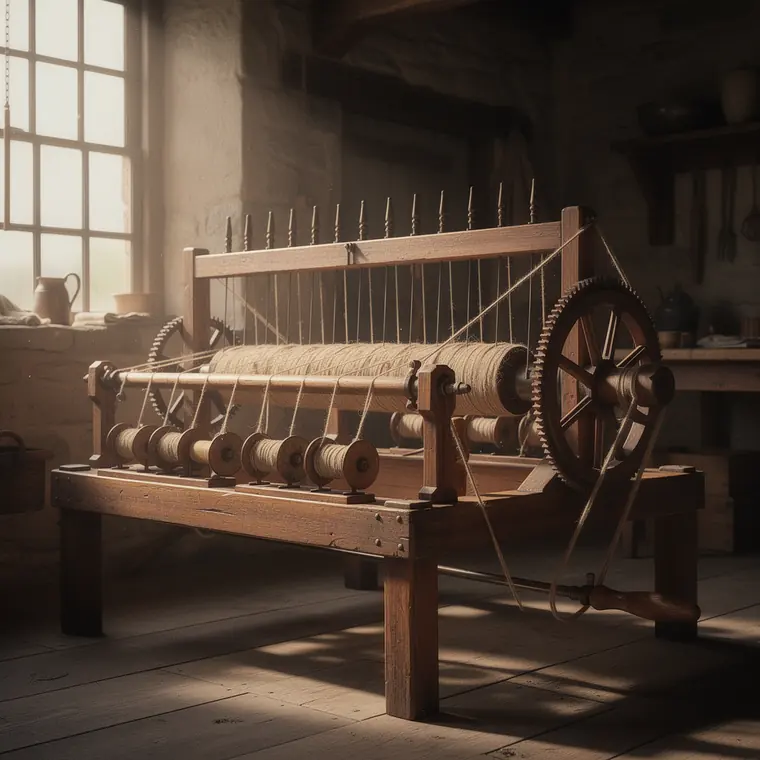
Hargreaves' spinning jenny in a Lancashire cottage room: a plain low wooden frame on legs, eight upright spindles in a row at one end, eight rovings on bobbins at the other, the threads running along the frame through the sliding clasp bar of two wooden bars that clamp together, the clasp bar drawn back along the top of the frame in the spinner's left hand while the right hand turns the large wooden hand wheel that spins all the spindles by a band, a faller wire to guide the yarn, the whole of wood and cord.
- What it was used for
- At first James Hargreaves span for his own use: by Baines's account he and his family span the weft for his own weaving with the machine. From 1768 in Nottingham he built jennies for a Mr Shipley, then with the joiner Thomas James put up a small mill in Hockley where they span yarn for the hosiers; his widow testified in 1785 that it was a cotton factory for spinning jennies, "it was all for stockings". Jenny and water frame did not come into conflict but were used together, the jenny for weft. The famous poverty is not documented: after his own enquiries Baines held both Arkwright's claim that Hargreaves died "in obscurity and great distress" and the Edinburgh Review's statement that he died in the workhouse to be unfounded - he died in April 1778 at his own house near the mill, and his widow received £400.
- What was new
- Patent no. 962, sealed on 12 June 1770, describes a machine "to be managed by one person only, which will spin, draw, and twist 16 or more threads at a time by a motion of one hand and a draw of the other" - that is the difference from the single-spindle wheel, which gave one thread per person. Baines gives the spindle counts: eight at first, sixteen at the patent, soon twenty or thirty, later as many as a hundred and twenty. It was not the first attempt: the Society of Arts held models of competing spinning wheels from 1761 to 1767, and Baines writes that none of these inventions succeeded. The dating is disputed - 1764 by the Society of Arts' Transactions of 1783, 1767 by Arkwright's printed "Case"; Baines separates the conception (1764) from the execution. The legend of the overturned wheel of a daughter named Jenny does not hold: Lancashire Museums record that neither his wife nor any daughter was called Jenny, and that "ginne" was a common Lancashire corruption of "engine".
Further reading
- Great Britain Patent Office (Woodcroft), Titles of Patents of Invention 1617-1852, Part I (Nr. 962, 12. Juni 1770, amtlicher Wortlaut)
- Edward Baines, History of the Cotton Manufacture in Great Britain, 1835 (Spindelzahlen, Datierungsstreit, Nottingham, Tod und Nachlass)
- Lancashire County Council Museum Service: James Hargreaves and the Spinning Jenny (Widerlegung der Jenny-Legende)
- The trial of a cause instituted by Richard Pepper Arden ... London 1785 (Aussage Elizabeth Hargrave)