Crompton Fancy Loom
1837 · Fancy Loom · Work 302 of 1,871
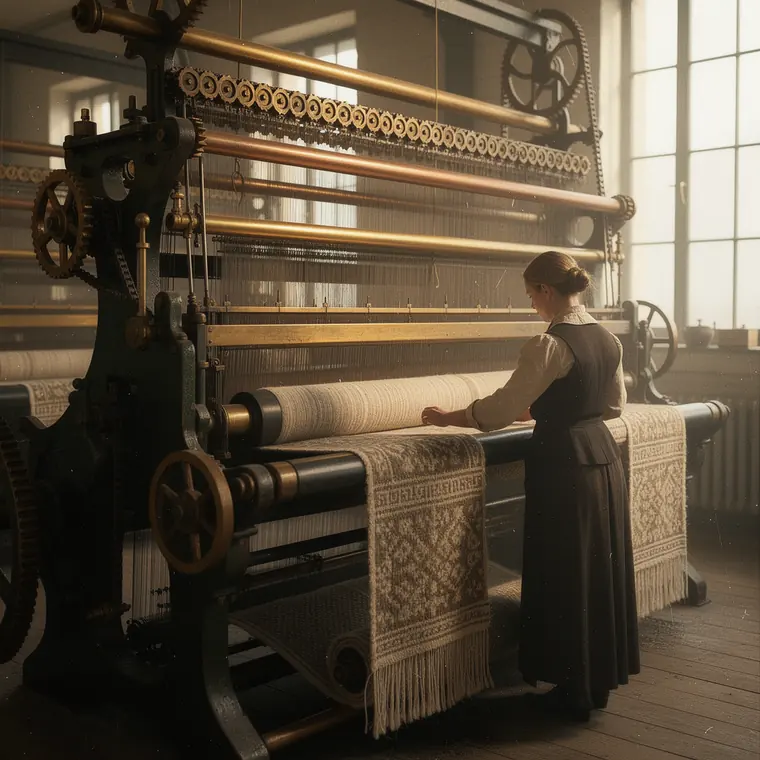
William Crompton's fancy weave power loom in a Massachusetts woollen mill, a revolving pattern chain of pegged bars lifting many harnesses to build a figured worsted cloth.
- What it was used for
- Figured cloth on the power loom. US patent No. 491, granted 25 November 1837 to William Crompton of Taunton, Massachusetts - not Samuel Crompton, who built the mule. Crompton had been a hand-loom weaver in Lancashire, then a machinist and superintendent of a cotton mill at Ramsbottom. Nutt records in 1919 that the loom's success was demonstrated in 1840, when fancy woollen cloth was woven by power at the Middlesex Mills in Lowell on looms fitted with Crompton's device. The first looms built on his patents were narrow and ran at forty-five picks a minute; his son George's loom of 1857 was nearly twice as wide and ran at eighty-five. When George Crompton died in December 1886 the Crompton Loom Works employed nearly one thousand men.
- What was new
- The patent has numbered claims; what is claimed is the entire manner of constructing and combining the apparatus for working the jacks, together with the two notched wheels on the upper shaft for working the pick. Until then cams controlled the shafts; their number was practically limited, and changing from one pattern to another was difficult. Crompton replaced them with bolts carrying movable rollers on a cylinder, and states expressly that where more changes are required than a single cylinder allows, they are arranged as an endless chain of bolts and rollers passing round two cylinders. The length of the repeat was thereby no longer bounded by the circumference of a single cylinder. In 1838 he went to England and patented the loom there as well.
Further reading
- US-Patentschrift Nr. 491, Figure Power-Loom, William Crompton, Taunton, Mass., erteilt 25.11.1837 (inkl. Disclaimers von 1857)
- Charles Nutt, History of Worcester and Its People, New York 1919, Bd. IV, S. 856-858 (Middlesex Mills 1840, 45 und 85 Schuss/Min., tausend Beschäftigte 1886)
- Massachusetts Historical Commission / National Register nomination, Crompton Loom Works, Worcester (NRIS 80000541)
- Extension of a Patent, Scientific American, 12. Juni 1858, Bd. 13 Nr. 40, S. 317 (Vormund, 15 Dollar je Webstuhl)
- Worcester Historical Museum, Findbuch Crompton and Knowles Loom Works Collection 1999.161
- US-Patent 491 (William Crompton, 1837), Google Patents
- Appletons' Cyclopaedia of American Biography (1887): Crompton, William (Wikisource)