Heathcoat Bobbinet
1808 · Bobbinet Lace Machine · Work 305 of 1,871
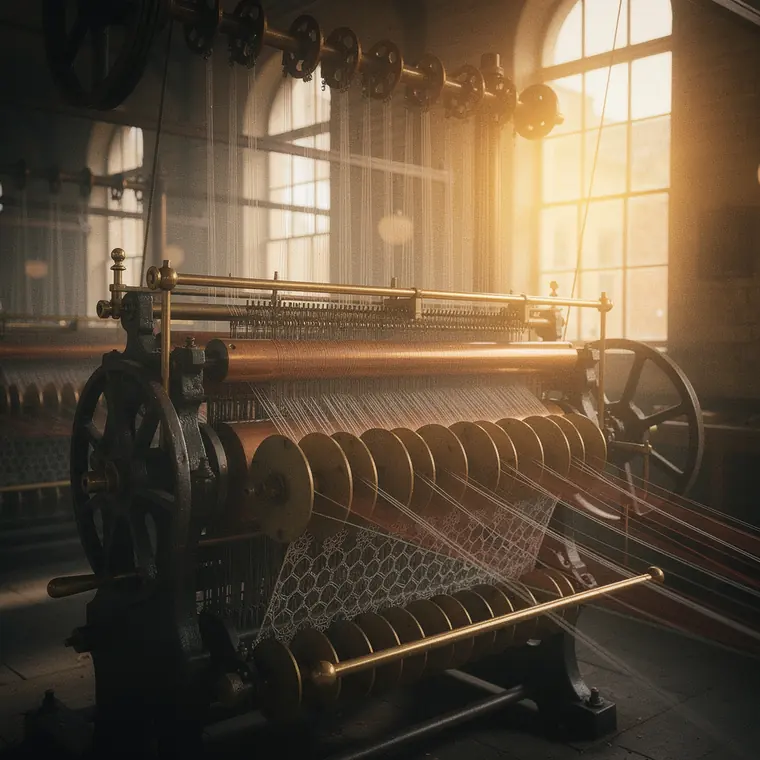
John Heathcoat's bobbinet machine in a Loughborough lace factory, flat disc bobbins swinging in their carriages between warp threads to twist a hexagonal net.
- What it was used for
- Machine-made net as a ground for lace. The patent calls it a machine for making bobbin lace, or lace nearly resembling French lace, and names Heathcoat as a lace manufacturer of Loughborough in the county of Leicester. Patent No. 3151, granted 14 July 1808; patent No. 3216, granted 20 March 1809 - Felkin dates the second to 14 July 1809, which could not be reconciled. There were 55 frames at Loughborough in 1816. On the night of 28 June 1816 seventeen men destroyed them together with the lace on them; Felkin puts the value at 8,000 to 10,000 pounds. Heathcoat then moved to Tiverton in Devonshire to get, in his words, as far as possible from the frame breakers, to a mill driven by the Exe, where in the end three hundred machines were at work.
- What was new
- The problem was not making net but getting twist and traverse at once. Felkin writes that the predecessors had got the twist but not the traverse, the latter being essential to the soundness of the twisted net. Heathcoat's 1808 machine carried two systems of threads, each pair through a conical tube with a pinion at its foot, all pinions set on a circle and turned together by racks; the 1809 patent brought the second machine, which made net of any width, later known as the Old Loughborough. Who owned what was disputed. A Nottingham topography recorded that it was insinuated by certain individuals, perhaps envious ones, that he had borrowed the invention from Lindley and Whittaker. Felkin himself credits Lindley and Whittaker with the bobbin, Robert Brown with sinker and bobbin, Charles Hood with the most skilful application - but Heathcoat with the merit of having invented the twisting and traversing bobbin net machine.
Further reading
- Patent Office (Bennet Woodcroft), Chronological Index of Patents of Invention 1617-1852 (Grants Nr. 3151 vom 14.7.1808 und Nr. 3216 vom 20.3.1809)
- William Felkin, A History of the Machine-wrought Hosiery and Lace Manufactures, London 1867, S. 168-242
- Knitting Together (Leicester City Council / New Walk Museum), John Heathcoat 1783-1861
- Grace's Guide: John Heathcoat (55 zerstörte Rahmen, 10.000 Pfund vom King's Bench festgesetzt, nie angenommen)