Singer Treadle Machine
1851 · Lockstitch Sewing Machine · Work 309 of 1,871
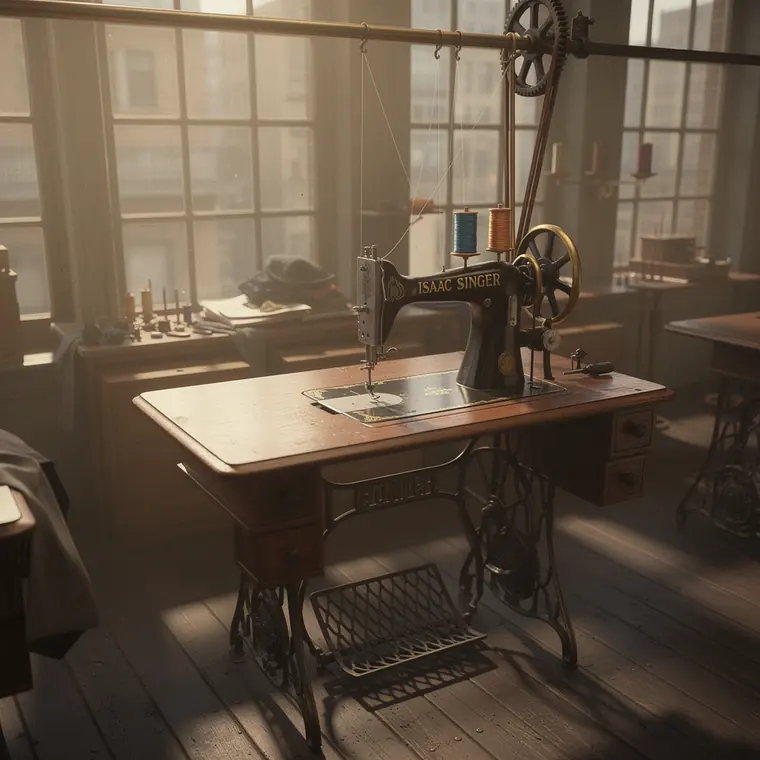
Isaac Singer's sewing machine on a treadle table in a New York shop, a straight vertical needle with a rigid overhanging arm and a spring presser foot holding seams.
- What it was used for
- Isaac Merritt Singer was granted US patent 8,294 on 12 August 1851. The Smithsonian, which holds the patent model, records that this early version was engineered for commercial manufacturing rather than home use; the wooden treadle left the seamstress both hands free to guide the cloth. Domestic machines came later: a lightweight Family machine in 1858, the New Family in 1865. On time saved, the Museum of American Heritage, citing Godey's Lady's Book, gives about fourteen hours of hand work for a man's shirt against one and a quarter hours on the machine. On price the same source gives 75 dollars for Singer's machines in the 1850s and, elsewhere, about 125 dollars for a sewing machine in general, against an average annual income of some 500 dollars.
- What was new
- Howe's machine used a curved needle swinging horizontally and pinned the cloth to a baster plate; Singer used a straight needle moving vertically above a horizontal table, so that cloth of any length could be guided freely. The Smithsonian lists three points of the patent: the additional forward motion of the shuttle to tighten the stitch, a friction pad controlling thread tension, and the spool on an adjustable arm. The treadle is not among them. Neither man invented the lock stitch: Walter Hunt built such a machine in the early 1830s, never applied for a patent, and because he abandoned it Howe's patent was upheld in 1854. Singer settled in 1854 for 15,000 dollars and a 25 dollar royalty per machine sold; in 1856 the litigants pooled their patents as the Sewing Machine Combination, the first patent pool in the United States.
Further reading
- Smithsonian National Museum of American History: 1851 Isaac Singer's Sewing Machine Patent Model
- Bard Graduate Center: Number 1 Standard Sewing Machine
- Library of Congress: Elias Howe Issued a Patent for the Sewing Machine
- Lemelson-MIT Program: Walter Hunt
- Smithsonian NMAH: 1846 Elias Howe Jr.'s Sewing Machine Patent Model
- Science Museum Group: Singer 'New Family' sewing machine, 1865-1883