Cotton Patent Frame
1864 · Cotton Patent Knitting Frame · Work 310 of 1,871
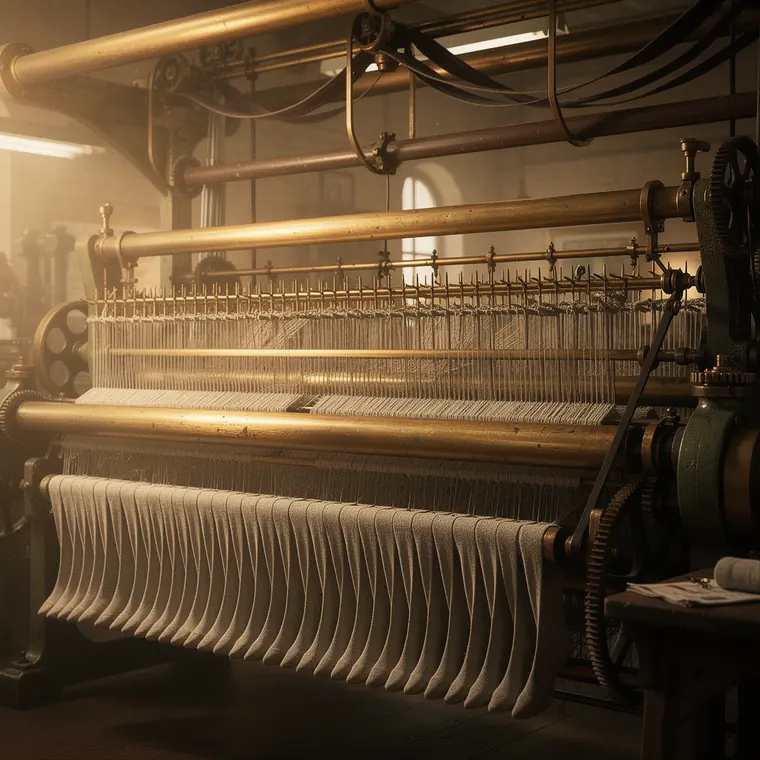
William Cotton's patent knitting frame in a Loughborough hosiery factory, several stocking blanks shaped at once on one long bar of bearded needles with narrowing points.
- What it was used for
- William Cotton, apprenticed in Loughborough to the hosiers Cartwright and Warner, built a straight-bar frame for fully fashioned hosiery and garment pieces. The Nottingham Manufacturing Company bought the British rights to the 1864 patent; from the 1870s Cotton manufactured in his own works at Pinfold Gate. William Davis, in Hosiery Manufacture of 1920, describes Cotton's Patent Rotary frame as built to work as many as twelve full width articles at the same time, and twenty-four in hose, where two articles go into one division. A hand frame makes one. Some eighty years after Cotton's death the type lost the stocking market: with nylon and Italian circular machines from 1961 the time per stocking fell from fifteen minutes around 1950 to thirty seconds around 1980; major British firms sold off or scrapped their machines, others converted them to outerwear.
- What was new
- On Lee's hand frame the needles lie horizontal and fixed and hand and foot move everything; on Cotton's the needle bed is turned through ninety degrees, the needles stand vertical in a bar, and narrowing points above the machine transfer loops from needle to needle. That let the machine reduce the number of loops in a course automatically, and the Victoria County History names exactly this missing capability as the obstacle that had held back power-driven frames in the hosiery trade. A. Paget and Co. was working on fashioning machines in the same town. On dating: Knitting Together gives patents of 1863 and 1864, the Victoria County History a first success in 1864; no patent number could be established. After the patent expired in 1879 competitors built identical machines, and the inventor's name became a generic term for other firms' frames.
Further reading
- William Davis, Hosiery Manufacture, Sir Isaac Pitman and Sons, London 1920 (Volltext, Project Gutenberg)
- Victoria County History, Leicestershire vol. 4: Hosiery manufacture, pp. 303-314
- Knitting Together: William Cotton (c.1819-1887)
- Knitting Together: Seamless Succeeds
- Knitting Together: Building the Knitting Machines