Mill Rotative Engine
1782 · Rotative Beam Engine · Work 316 of 1,871
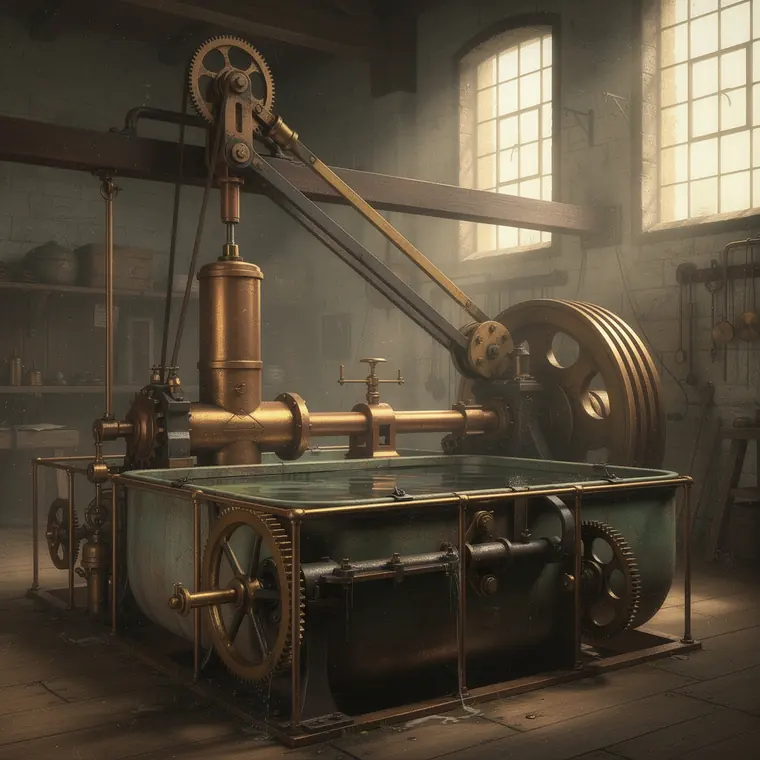
A Boulton and Watt rotative beam engine in a mill engine house: a great rocking beam overhead pivoted at its centre on the wall, a single upright cylinder standing beneath one end, the piston rod carried to the beam by the parallel motion linkage of hinged rods, at the other end the connecting rod descending to the sun and planet gearing, a small planet wheel fixed on the rod circling the sun wheel on the flywheel shaft, the large flywheel turning beside it, the separate condenser in its cold water cistern below the cylinder.
- What it was used for
- The rotative engine turned the beam into a shaft with a flywheel and so into a drive for line shafting. Boulton and Watt's first rotative engine went to Wilkinson's Bradley Works in 1783; the surviving Whitbread engine of 1785 had a 24 inch bore, a six foot stroke and about 17 indicated horsepower, about 35 after conversion to double acting in 1795, and it ran until 1887. By the end of the partnership in 1800 Boulton and Watt had built 451 engines, 268 of them rotative. The Robinsons in the Leen valley, who bought such an engine in 1785, had already spent over 40,000 pounds on ponds and leats: by the local source they turned to steam because Lord Byron began damming the Leen upstream in April 1785 and water ran short; the engine was to supplement the water wheel and failed to live up to expectations.
- What was new
- The Newcomen engine and the early Watt engine produced stroke and pull and were therefore used almost only for pumping; the patent of 25 October 1781 describes five ways of turning that into rotary motion, and chiefly one of them, the sun and planet gear, went into production, not because it was the best but because James Pickard's crank patent of 1780 blocked the obvious route. The patent of 12 March 1782 describes double acting working, which delivers power on every half stroke and gives a more regular motion. When such an engine first drove a cotton mill is unresolved: for Papplewick the local sources give the purchase in 1785 and the Nottinghamshire Historic Environment Record the installation in 1786, and that record contradicts itself between two of its own entries as to which mill the engine stood in.
Further reading
- Science Museum Group Collection: Rotative steam engine by Boulton and Watt, 1788 (Lap Engine, co50948)
- ASME Landmark: Boulton and Watt Rotative Steam Engine 1785 (Whitbread Engine)
- DATAMP: Patent GB 1306 (1781), James Watt, rotative motion
- Nottinghamshire Historic Environment Record M5288: Lower Mill; Middle Mill, Hucknall
- Papplewick Parish Council: The Leen Mills history
- Grace's Guide: Boulton and Watt
- Robinson/Musson, James Watt and the Steam Revolution (1969), Transkription The Hopkin Thomas Project