Ditherington Flax Mill
1797 · Iron Framed Mill · Work 318 of 1,871
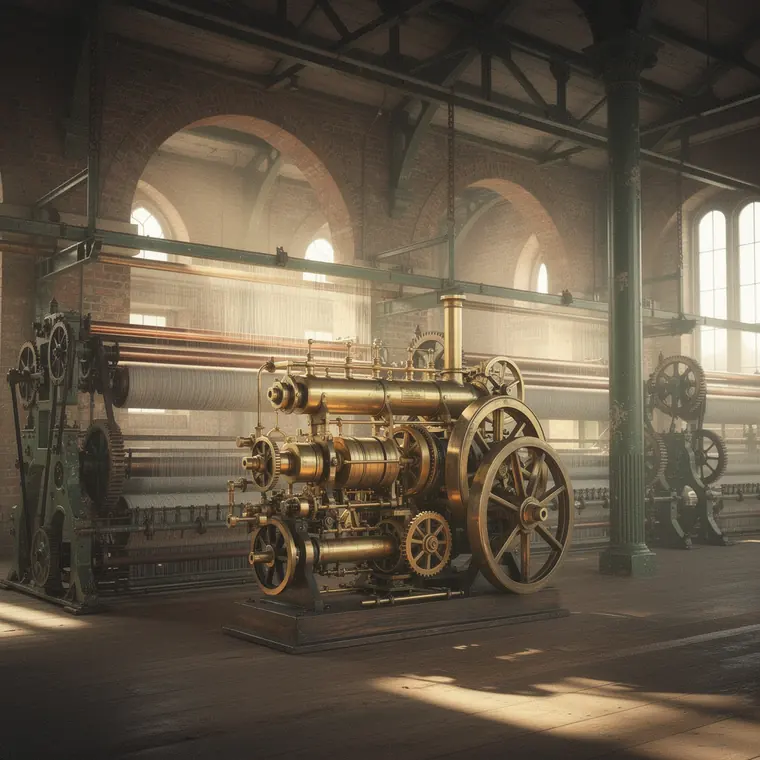
Ditherington Flax Mill at Shrewsbury, a five storey block framed throughout with iron columns and beams carrying brick jack arches, flax spinning frames standing between the pillars.
- What it was used for
- The flax mill of Marshall, Benyon and Bage in Shrewsbury was an answer to a fire: the partners' Leeds mill had burnt down in 1796. The building cost 17,000 pounds including plant; when the partnership was dissolved in 1804 the mill was valued at 64,000 pounds. Five storeys, eighteen bays, about 53 by 11 metres, 204 cast iron columns and 136 beams. Power in 1797 was a Boulton and Watt beam engine of 20 horsepower, joined from 1800 by a second of 40. In 1813 it employed over 400 people, in the 1840s about 800, making it the largest employer in the town. Flax was spun until October 1886; after that the building was a maltings until 1987.
- What was new
- William Strutt had set cast iron columns at Derby in 1792-93, but the beams above them stayed timber, plastered underneath against fire; Charles Bage replaced those beams with cast iron beams of inverted Y section, so that no timber was exposed in the working areas. The Institution of Civil Engineers states that Bage's correspondence with Strutt contains the earliest known analysis of the strength of iron beams and columns; Bage himself credited Strutt with teaching them to make buildings fireproof. Historic England's list entry dates the mill 1796 to 1800 and explains why: in 1796-97 it had six full and two short bays, and a ten-bay extension was added soon after 1797 but before 1800. The test came in 1811: on 24 October the Cross Building burnt out, which unlike the main mill was not of fireproof construction, and a fireproof staircase kept the fire out of the main mill.
Further reading
- Historic England, Listeneintrag 1270576: Ditherington Flax Mill, Spinning Mill (Grade I)
- Historic England, Listeneintrag 1428700: Cross Building, Shrewsbury Flaxmill Maltings
- Oxford Archaeology: Ditherington Flax Mill, Archaeological Watching Brief (Bericht)
- Institution of Civil Engineers: Shrewsbury Flaxmill Maltings, Industrial Icon
- Grace's Guide: Ditherington Flax Mill, Shrewsbury
- Revolutionary Players (Malcolm Dick): Charles Bage and Iron Construction
- Friends of the Flaxmill Maltings: Shrewsbury Flaxmill Maltings Story
- Shrewsbury Local History: Bage Way (Street Names)
- Grace's Guide: William Strutt