Fourneyron Turbine
1827 · Water Turbine · Work 319 of 1,871
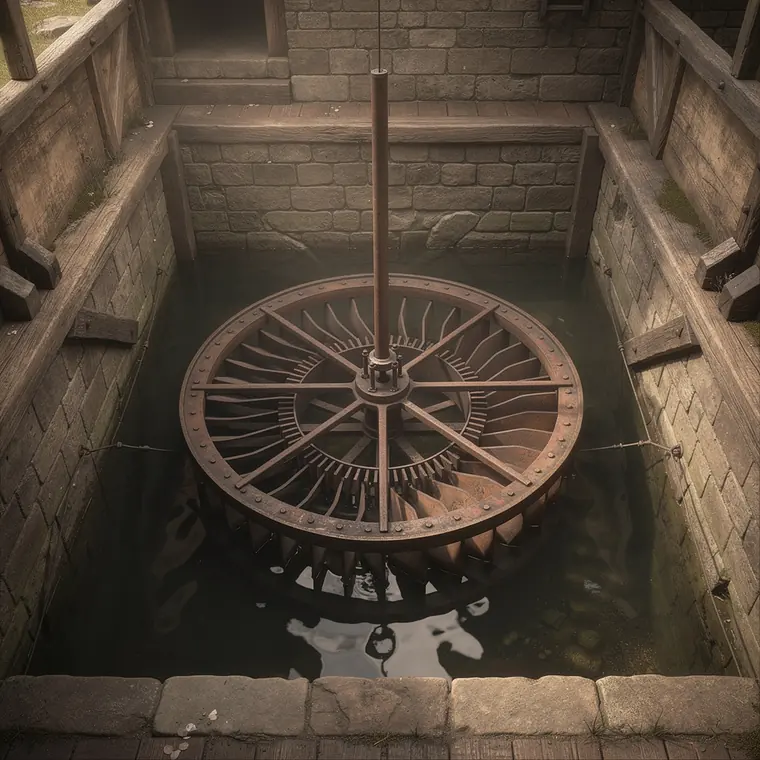
A Fourneyron outward flow water turbine seen from above in an open masonry wheel pit: the turbine a flat iron wheel lying horizontally like a millstone, submerged just under the surface of the water at the bottom of the pit, seen from above as a broad circular disc of curved blades with a smaller ring of fixed guide vanes at its centre, a vertical iron shaft rising from the centre of the disc straight up through the pit to the mill floor above, water welling up through the centre and streaming outward over the rim of the disc, the shaft the only upright element, the wheel itself lying flat.
- What it was used for
- Benoît Fourneyron, a graduate of the École des Mines at Saint-Étienne, installed his first working turbine at the Forges de Pont-sur-l'Ognon in the Haute-Saône in 1827: six horsepower on a head of 1.40 metres, intended to drive a saw, a lathe and a grindstone. Hunter Rouse, in the Dictionary of Scientific Biography, gives an efficiency of about eighty per cent, measured by the first practical application of the newly invented Prony brake, and more than a hundred turbines built by Fourneyron; by 1843 some 129 works are said to have been fitted out on his calculations. The Société d'encouragement pour l'industrie nationale had offered a prize in 1826 for the application of hydraulic turbines on a large scale; it was awarded to Fourneyron with 6,000 francs, in 1833 according to the Musée des arts et métiers, in 1834 by another account.
- What was new
- The water wheel at Pont-sur-l'Ognon was, by Hunter Rouse's account, of low efficiency; according to the Musée des arts et métiers, Fourneyron's runner could also work submerged and under any head. The word turbine is not his but his teacher Claude Burdin's, who by Hunter Rouse's account remained a theoretician and never produced a working model. The type reached the United States around 1843 and was improved there by Uriah Boyden in 1844, but was later superseded by the inward-flow turbine, patented by S. B. Howd in 1838 and greatly improved by J. B. Francis in 1849; according to ASME, Fourneyron turbines were still used in the original Niagara Falls hydroelectric installation in 1895.
Further reading
- POP / Base Mérimée IA70000081: Usine de transformation des métaux dite forges de Pont-sur-l'Ognon
- Hunter Rouse: Fourneyron, Benoît, Dictionary of Scientific Biography
- Musée des arts et métiers: Modèle, turbine hydraulique
- ASME Landmark: The 102-inch Boyden Hydraulic Turbines at Harmony Mill No. 3, Cohoes
- Millénaire 3, Grand Lyon: Benoît Fourneyron (1802-1867)