Salts Mill
1853 · Integrated Textile Mill · Work 320 of 1,871
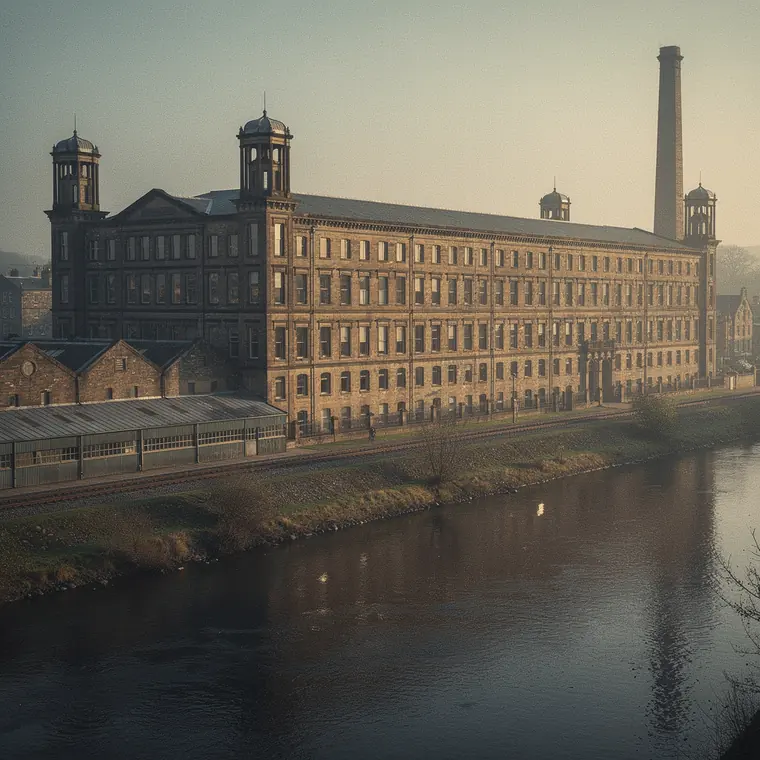
Titus Salt's mill at Saltaire beside the river Aire and the canal: a long stone mill block of many storeys in the Italianate style, ranks of windows in even rows along the whole front, two matching turrets capped by belvederes flanking the central entrance arches, the tall Italianate chimney tower rising beside it, the railway line passing along the mill, the warehouse reaching toward the canal, alpaca weaving sheds spreading behind it, the river flowing past, the building seen from outside across the water.
- What it was used for
- Titus Salt opened his worsted and alpaca mill near Bradford on 20 September 1853, his fiftieth birthday; according to the conference report Crisis at Saltaire in the Bradford Antiquary, 2,440 workers were brought from Bradford by special train and fed in the combing shed. The works employed about 3,000 people, ran 1,200 looms and turned out 30,000 yards of cloth a working day. The Institution of Civil Engineers gives two beam engines of 1,250 horsepower each, ten boilers and a building cost of 100,000 pounds. On the ICOMOS evaluation the south front measures 166 metres by 22 metres high in sixty bays, the chimney 68 metres.
- What was new
- The Saltaire Collection calls Salts Mill a vertical mill where all processes took place; a mid-twentieth-century booklet of the firm describes thirteen stages from sorting the wool through scouring, carding, combing, spinning, twisting and weaving to dyeing and finishing, whereas nineteenth-century production was often spread across several sites. It was built fireproof with cast iron columns and beams and stone floors on hollow brick vaults; the engineer William Fairbairn tested no fewer than 400 beams. The model village came afterwards: the more than 800 dwellings were built between 1854 and 1868. No public houses were allowed in the village, and Linstrum records that the whole town remained under the control of Salt himself and his chosen architects, down to a ban on hanging washing across the streets.
Further reading
- ICOMOS Advisory Body Evaluation: Saltaire (No 1028), September 2001, UNESCO World Heritage Centre
- Institution of Civil Engineers: Salts Mill
- Saltaire Collection: The Foundation of Saltaire
- Saltaire Collection: Turning wool into cloth (Betriebsheft Salts (Saltaire) Ltd.)
- Crisis at Saltaire (Tagungsbericht mit Derek Linstrums Vortrag), The Bradford Antiquary, 3rd series vol. 3 (1987), S. 1-10
- Historic England, Listeneintrag 1133523: Saltaire Mills, Main Block Including Sheds
- Saltaire Collection: William Fairbairn, 1789-1874
- Saltaire Collection, Heritage Trail: Don't tell Titus