Geordie Lamp
1815 · Safety Lamp with Perforated Metal Shield · Work 335 of 1,871
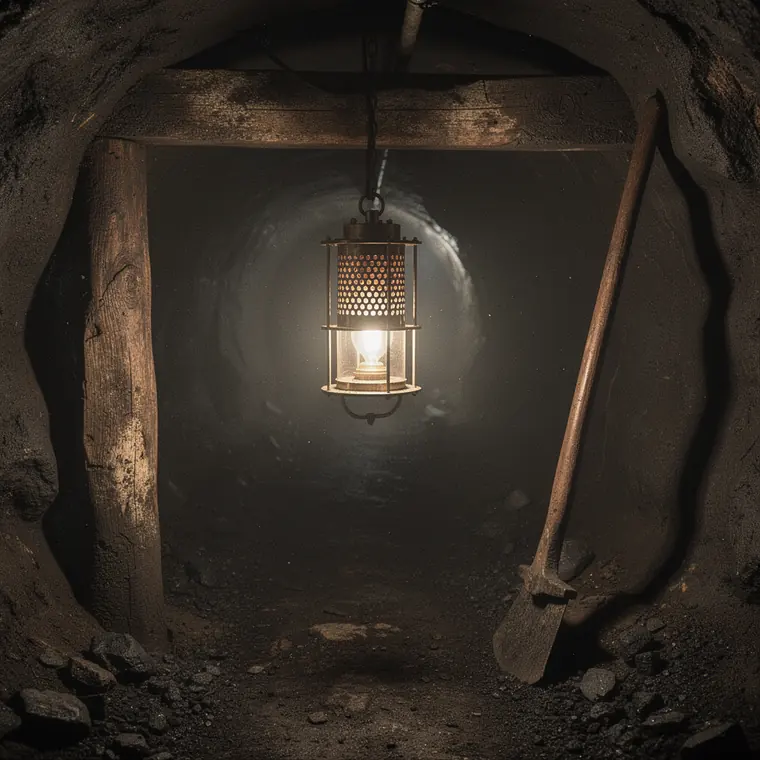
George Stephenson's Geordie lamp hanging from a timber prop at Killingworth colliery, its perforated metal cylinder and glass tube around the wick, with a hewer's pick leaning nearby.
- What it was used for
- George Stephenson was engine-wright at Killingworth Colliery near Newcastle, and that is where his lamp was needed. The Pitt Rivers Museum calls the miners' safety lamp first and foremost a methane detector. The prototype was tested at a gas-issuing fissure at Killingworth on 21 October 1815 - one source calls that first trial a comparative failure - improved versions on 4 and 30 November, and in December 1815 the lamp was shown in Newcastle; accounts differ on the day, naming both 5 and 21 December. The lamp stayed regional: unlike the Davy lamp it was used exclusively in the pits of north east England. Neither inventor took out a patent. Stephenson later adopted Davy's gauze, and that revised design is what the nineteenth century called the Geordie lamp.
- What was new
- Not the first safety lamp but a different route: Stephenson admitted air through narrow tubes and left a space above the flame for burnt air, which prevented the flame passing upwards - Davy enclosed the flame in wire gauze. Who was first stayed open for a long time: the Killingworth trial came a month before Davy presented his design to the Royal Society, a coal owners' meeting credited Davy with the invention on 11 October 1816, a Newcastle enquiry committee cleared Stephenson in 1817 and awarded him 1,000 pounds, and only in 1833 did a House of Commons committee give him equal claim. In 1816 Davy received 2,000 pounds as a public testimonial, Stephenson 100 guineas. The barb: what the lamp achieved is disputed. Eric Edwards, author of the Pitt Rivers Museum page, writes that after the Davy lamp was introduced explosions increased partly because dangerous pits were reopened; the Royal Institution reports that deaths per million tons of coal fell enormously.
Further reading
- Pitt Rivers Museum, University of Oxford: The Miners' Safety Lamp (Eric Edwards, 2009)
- Newcastle University Special Collections, Sir Humphrey Davy's Harmful Emissions
- Royal Institution, Humphry Davy's miners' safety lamp
- North East Museums, Our Past, Your Future: Geordie Lamp 1815
- Welsh Miners Lamps, Lamp History