Ingersoll-Bohrmaschine
1871 · Compressed Air Rock Drill · Work 346 of 1,871
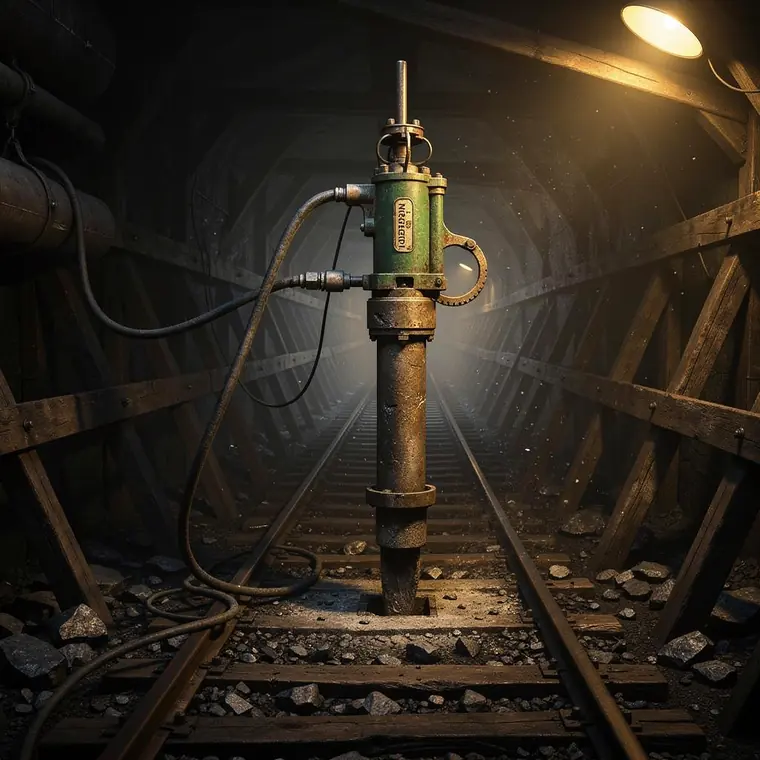
An Ingersoll compressed air rock drill clamped to a column bar at a Pennsylvania anthracite heading, its air hose running back along the timbered gangway to the receiver.
- What it was used for
- A rock drill on a tripod, for driving levels, adits and tunnels. It bored the shot holes that had previously been struck by two or three men with hammer and drill steel. Simon Ingersoll of Brooklyn states in the patent that a full-sized working drill with his improvements does not exceed 360 pounds and can be moved by two men; the legs of the tripod could be adjusted separately, so the drill could be set horizontal without disturbing the legs. The printed patent head reads: Letters Patent No. 112,254, dated February 28, 1871. ASME gives 7 March 1871; the document is to be followed. 29 February 1871 is impossible - 1871 was not a leap year.
- What was new
- Not the first percussion rock drill: Couch patented one in 1849, Fowle in 1851, Burleigh's machines went into service in the Hoosac tunnel on 31 October 1866, Sommeiller bored at Mont Cenis with compressed air, and Addison Rand, founder of the Rand Drill Company, came to New York in the same year, 1871. Ingersoll's claims cover three things: a feed rod and plunger giving automatic feed, the transfer of that motion to a pawl and ratchet nut, and the construction of the tripod; the slightly twisted square bar turned the drill a little at every stroke. A correction: the patent describes a steam machine with a steam chest, not compressed air, which came later. The barb: machine drilling made fine quartz dust; by 1900 the early mechanised drills were called widow makers. Leyner's hammer drill of 1897 blew the cuttings out with air, water came only afterwards, and at the Hawk's Nest Tunnel they were still drilling dry in the 1930s.
Further reading
- US Patent 112,254, Simon Ingersoll, Improvement in Rock-Drills, dated February 28, 1871
- ASME: Simon Ingersoll
- Invention & Technology: The Rock Drill and Civilization
- CDC/NIOSH: History of Silicosis
- Western Australian Museum: Working Underground (widow makers)
- National Park Service: The Hawk's Nest Tunnel Disaster
- International Directory of Company Histories: Ingersoll-Rand Company Ltd.