Bienenkorboefen von Connellsville
1880 · Beehive Coke Oven · Work 349 of 1,871
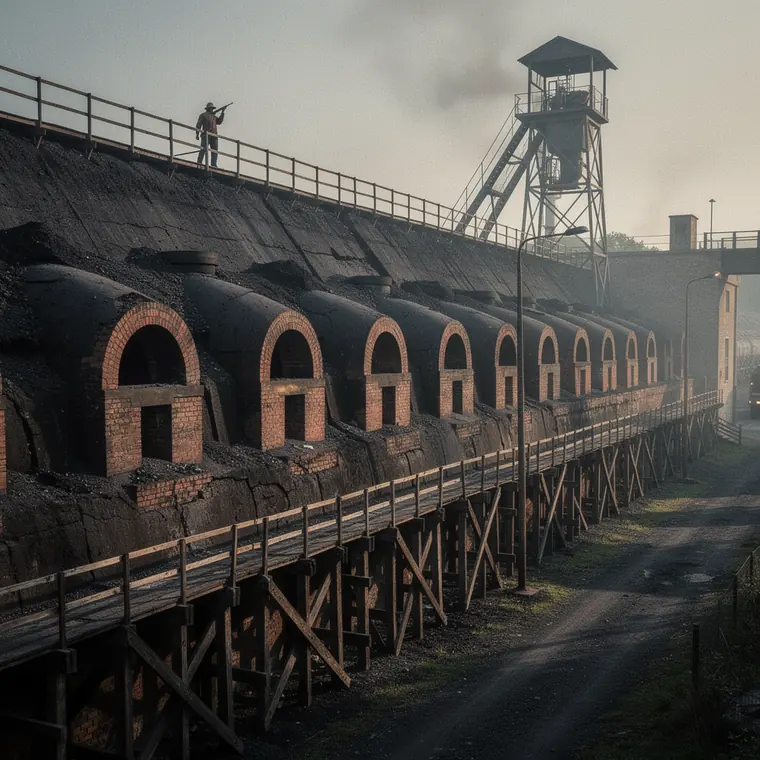
A long row of beehive coke ovens at Connellsville in Pennsylvania, domed brick chambers built into a bank with charging holes on top and a larryman walking the tracks above.
- What it was used for
- Brick beehive ovens in which the coal of the Pittsburgh seam was baked into metallurgical coke. They were charged from above through the trunnel head; the heat of the previous charge started the coking. The Coal and Coke Heritage Center at Penn State Fayette gives a usual coking time of 48 hours, 72 at weekends, about 850 gallons of quenching water per charge, and six ovens to a worker, of which he drew three a day. The oven counts are only usable with their reference area: about 550 ovens in the region in 1870; in 1910, according to the historical marker, 44,252 of Pennsylvania's 55,166 ovens lay in the Connellsville region; in 1913, according to the state historical commission, 38,000 ovens in the district supplied half the nation's metallurgical coke, carried away in 2,000 railcars a day.
- What was new
- Against the coking heap the oven was the advance: the state historical commission reckons the heap converted only about 50 per cent of a ton of coal into coke, the beehive oven as much as 70. The rest went into the air - a mixture of ammonia, tar, phenols and smoke; the by-product oven later captured the ammonia and tar. The Park Service's HAER documentation speaks of the intense pollution problems associated with beehive coking. In 1900 Alverton No. 1 mined over 100,000 tons of coal and produced 72,000 tons of coke. A contemporary wrote in 1880 that five thousand coke ovens were sending their pernicious fumes heavenward. The barb: in 1910 beehive ovens made over 80 per cent of American coke, by 1930 less than 6; the last went out in 1972, and their replacements were shut in 1983 because they could not meet clean air standards.
Further reading
- ExplorePAhistory (Pennsylvania Historical and Museum Commission), Marker Coke Ovens [Bituminous Coal]
- HAER No. PA-288, Alverton Coke Works, H. C. Frick Coke Company (Library of Congress)
- Coal and Coke Heritage Center, Penn State Fayette
- Pennsylvania Environmental Council, Connellsville Area Coke Oven Assessment
- HMdb.org, Marker Connellsville Coke (44.252 von 55.166 Öfen, 1910)
- ExplorePAhistory (Pennsylvania Historical and Museum Commission), Marker Coke Ovens [Steel]