The Glassmaker
1870 · Glassworks · Work 365 of 1,871
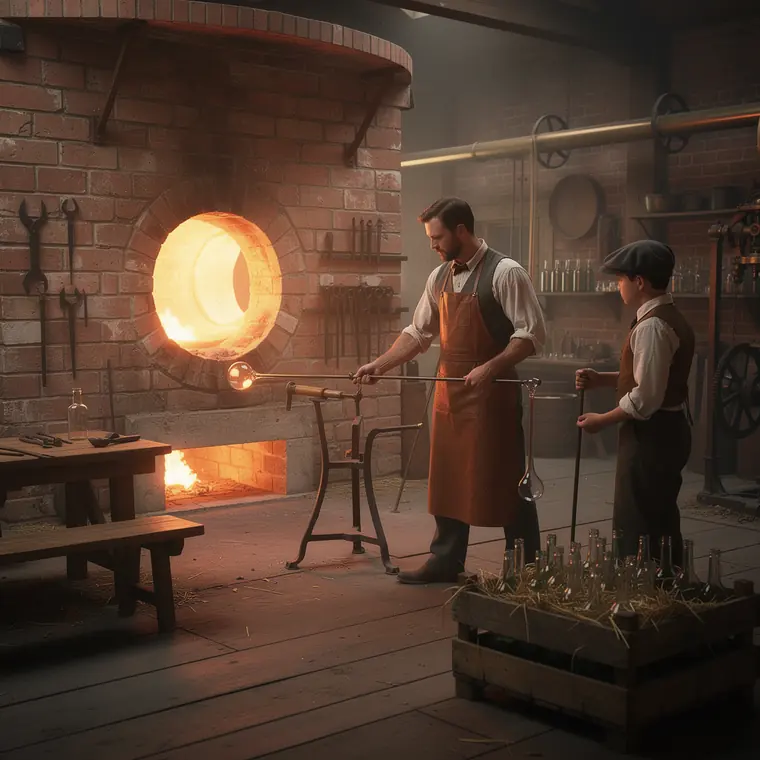
A glassmaker swinging a blowpipe over a pit in front of a furnace mouth: a brick-built glass furnace with a round glowing working hole, the glassblower in shirtsleeves, waistcoat and leather apron, the glowing gather of glass at the end of the long iron blowpipe, his gatherer boy in a cloth cap, shirt and waistcoat carrying an iron pontil, finished bottles stacked in a straw-lined crate, wooden benches and iron tools around, the shop lit by the furnace glow and daylight.
- What it was used for
- The glassmaker worked in a chair, a team of five to seven: the gaffer as master - the word, says the Corning Museum of Glass, is a corruption of grandfather - with blowers and finishers and three or four boys who fetched and carried. The boys' pace set the men's piece rate. Glass was gathered from a tank holding 30 to 100 tons. An ASME landmark brochure records that a shop of six turned out some 2,880 bottles a day, and that a blower earned around $200 a month in 1880. In the same year about 6,000 boys aged ten to fifteen worked in the American glass industry, a quarter of the workforce, ten-hour days, some for thirty cents.
- What was new
- Nothing about the process was new in 1870 - the scale was. Not a single movement was mechanised. That came later: Michael Owens's bottle machine, US patent 766,768, is described by ASME as the first commercially successful fully automatic machine when it ran in 1903; the AR model of 1912 averaged 50,400 bottles a day, and already the A model made bottles for ten to twelve cents a gross instead of $1.80 by hand. The patent was filed on 13 April 1903 and granted on 2 August 1904, and the National Inventors Hall of Fame gives a rate that contradicts the ASME figure by a factor of seven. In 1913 the National Child Labor Committee stated that the rapid introduction of the automatic machine had done more to eliminate child labour than it had been able to do through legislation.
Further reading
- ASME Landmark-Schrift, Owens AR Bottle Machine (Univ. of Toledo, PDF) - 2.880 Flaschen je Handshop, AR 50.400/Tag, Preise, 6.000 Jungen 1880, NCLC 1913
- University of Toledo, Batch, Blow, and Boys: The Glass Industry in the United States, 1820s-1900
- Corning Museum of Glass, Glaslexikon: Gaffer
- Corning Museum of Glass, Hot Glass Demos (Ofentemperatur 2.100 Grad Fahrenheit)
- National Inventors Hall of Fame, Michael J. Owens (Patentnummer 766.768; abweichende Leistungsangabe)
- Google Patents, US766768A, Michael J. Owens, Glass-shaping machine (angemeldet 13.4.1903, erteilt 2.8.1904)