The Fitting Shop
1890 · Engineering Workshop · Work 373 of 1,871
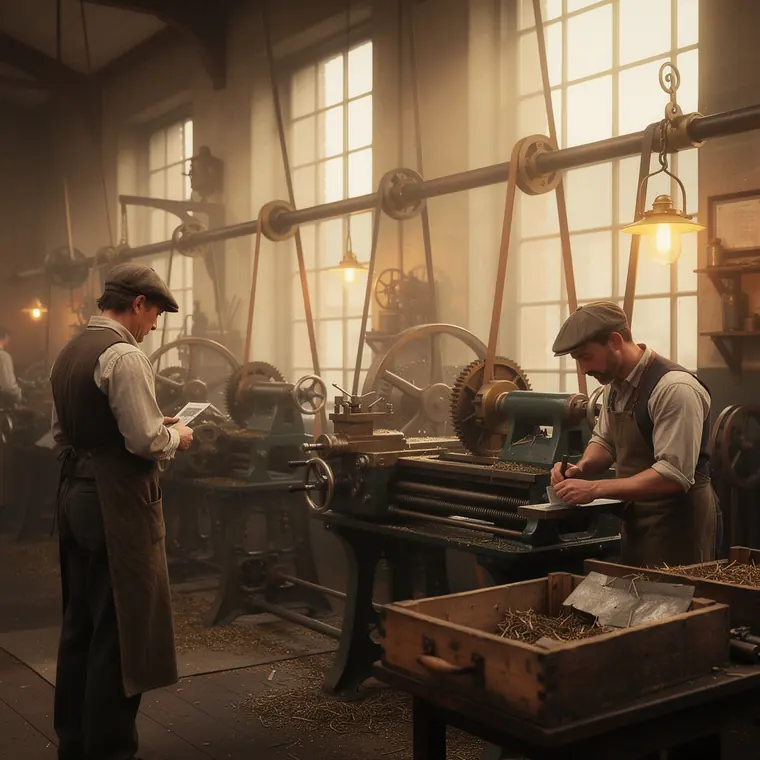
Fitters at a row of belt-driven lathes under a line shaft: heavy cast iron lathes on iron legs, each driven by a flat leather belt running down from a pulley on the overhead line shaft, one man scraping a bearing on the bench while swarf collects in wooden and sheet iron trays beneath the beds, the men in waistcoats, shirtsleeves, aprons and cloth caps, the shop lit by daylight through tall windows and gas lamps.
- What it was used for
- In the fitting shop of an engineering works men filed, scribed and fitted by hand at the vice, although the parts had already been machined. The reason was the absence of interchangeability: each nut belonged to its own bolt. Joseph Whitworth describes exactly this state of affairs in his 1841 paper on a uniform system of screw threads: the variety of threads adopted by different manufacturers made provision for repairs at once expensive and imperfect, ascertaining the exact pitch of a given thread was extremely awkward, and on railways the number of sets of apparatus required matched the number of manufacturers from whom the engines were bought. The fitter was therefore the man who made two out-of-tolerance parts meet, and with a replacement part the only man who could get it in at all.
- What was new
- What was new was not a thread but a worked-out, printed system for one: Whitworth collected bolts from leading English workshops and proposed one thread angle of 55 degrees for all sizes, graded from 20 threads per inch at quarter-inch diameter to two and a half at six inches. Jonathan H. Grossman argues in Technology and Culture that the text deliberately presented the standard not as a prescription but as a record of existing practice. On the kind of date: 1841 is the year the paper was read to the Institution of Civil Engineers, not a patent or statute date; the Newcomen Society dates the printing to 30 October 1841 in Mechanics' Magazine no. 951, pp. 340-344, and only the year is documented for the reading. The barb: the more precisely things were measured, the less was left to fit. Whitworth's measuring machine compared end measures to one millionth of an inch (IMechE: demonstrated in 1859), and in Shop Management (1903) Taylor required a clearly defined daily task for every man.
Further reading
- Joseph Whitworth, A Paper on an Uniform System of Screw Threads (Transkription des Originaltextes)
- Scan der Fassung On an uniform system of screw threads, communicated to the Institution of Civil Engineers, Druck 1842 (Zenodo)
- Newcomen Society, John Gardner: Vernacular Practice - Joseph Whitworth's papers on Flatness and Threads
- Jonathan H. Grossman: How Standards Became Documents. Technology and Culture 66:3 (2025), S. 649-673 (Abstract)
- Institution of Mechanical Engineers: The stunning sensitivity of the IMechE Archive's Millionth Machine
- Frederick Winslow Taylor: Shop Management, Volltext der Buchausgabe 1911 (Project Gutenberg)
- Taylor: Shop Management, ASME-Sonderdruck 1903 (presented at the Saratoga meeting, June 1903)