Odhner Arithmometer
1890 · Pinwheel · Work 416 of 1,871
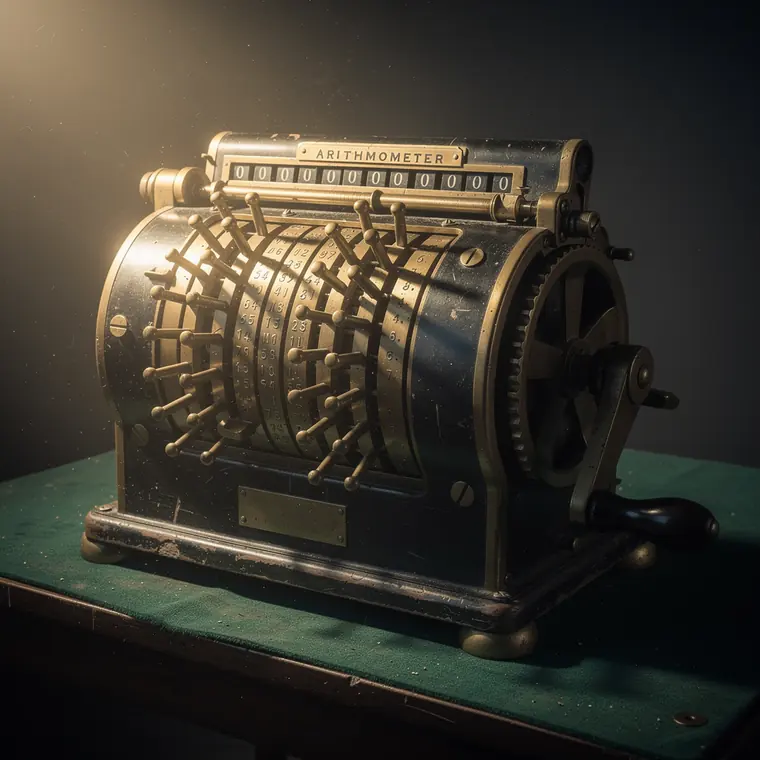
A pinwheel calculating machine built as a large drum lying on its side, a fan of nine radial setting levers on the face of the drum standing out like the spokes of a wheel, a sliding carriage of small numeral windows across the front, each window showing the single digit 0, a crank on the right with a black wooden grip, the drum housing plain black-painted iron with brass fittings, a plain brass plate on the front, an engraved plate above the setting drum reading "Arithmometer", standing on a dark baize-covered table before a deep neutral background, a single raking light from the left raking across the radial levers.
- What it was used for
- A pinwheel four-function machine built in St Petersburg. The Arithmeum describes the improved second design that went into production around 1890: 9 x 8 x 13 places, 6.3 kg, 12 x 29 x 15 cm. The Zuse Computer Museum calls it the first pinwheel machine made in series production and dates manufacture from 1886 in a workshop, from 1892 as factory production in Odhner's engineering works Odhner & Hill; the basis was patent DE 7393 of 1878. In 1914 the price list gave the successor model Original Odhner A at 200 roubles.
- What was new
- The Smithsonian names the pinwheel machine an invention of Frank S. Baldwin in the United States and of W. T. Odhner in Russia, and according to the Arithmeum Odhner began his development in the 1870s at about the time Baldwin was seeking a US patent. What can be documented is the effect, not the priority: the Arithmeum calls this second design the model for all later pinwheel machines on the Odhner principle, and the Smithsonian writes that Odhner's patents became the basis of Swedish, German, French and later American machines.