Consul the Educated Monkey
1916 · Pantograph Toy · Work 435 of 1,871
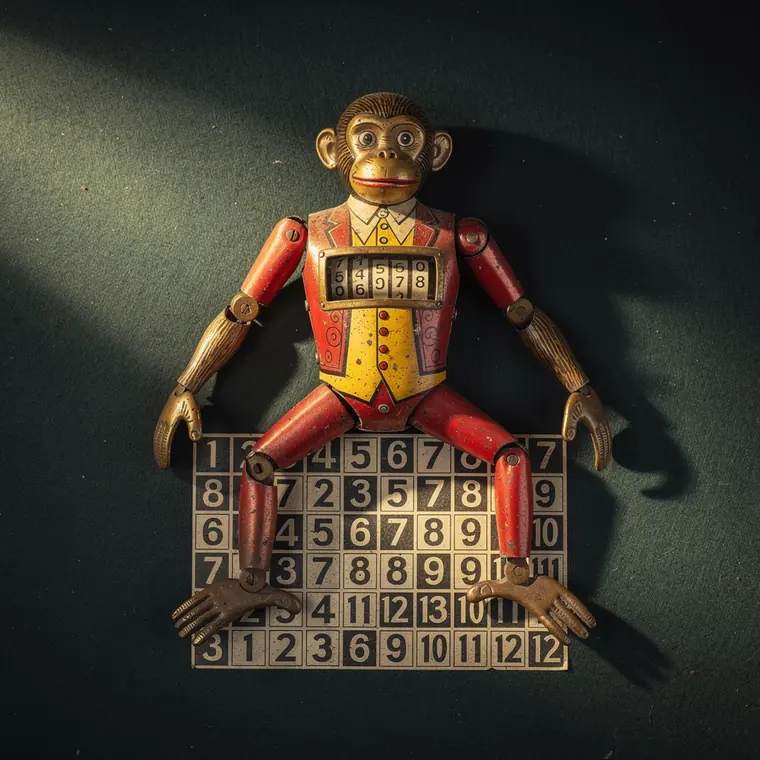
A lithographed tin figure of a monkey in a red jacket, its jointed legs spread to point at two numbers on a printed grid of small squares beneath it, each square holding a single number from 1 to 12, the product appearing in a small window at its chest, the tin printed in warm reds and yellows with black outlines, the toy lying flat on the table, standing on a dark baize-covered table before a deep neutral background, a single raking light from the left raking across the embossed tin.
- What it was used for
- A tin monkey of about 150 by 140 millimetres and seventy grams in weight, made by the Educational Novelty Company of Dayton, Ohio. The instructions accompanying it promised that it taught the multiplication tables to twelves with the associated division and factoring, and the addition tables to twelves. The instruction card also addressed teachers and described an arithmetic game for school classes; actual use in schools is not documented. Its inventor, William Henry Robertson, was a draftsman at National Cash Register and previously a secondary school mathematics teacher.
- What was new
- It is not a register but a linkage: set the two feet on two numbers and the hands point at the product. The results are printed as a triangular table on the back plate, and the hands encircle the right field in it; running totals it could not do. Patent US 1,188,490 was granted on 27 June 1916, a second one, US 1,286,112, on 26 November 1918. The barb sits in the middle of the times table: the feet cannot point at the same number, so squares need the extra field beside the twelve. The fate of the maker is unclear: according to MAA Convergence the Educational Novelty Company had already gone out of business by 1917 and the rights passed to Springfield, Massachusetts; Scherphuis instead describes a move and, around 1920, a renaming to Educational Toy Manufacturing Company.