Hebern Electric Code Machine
1918 · Hebern Rotor · Work 454 of 1,871
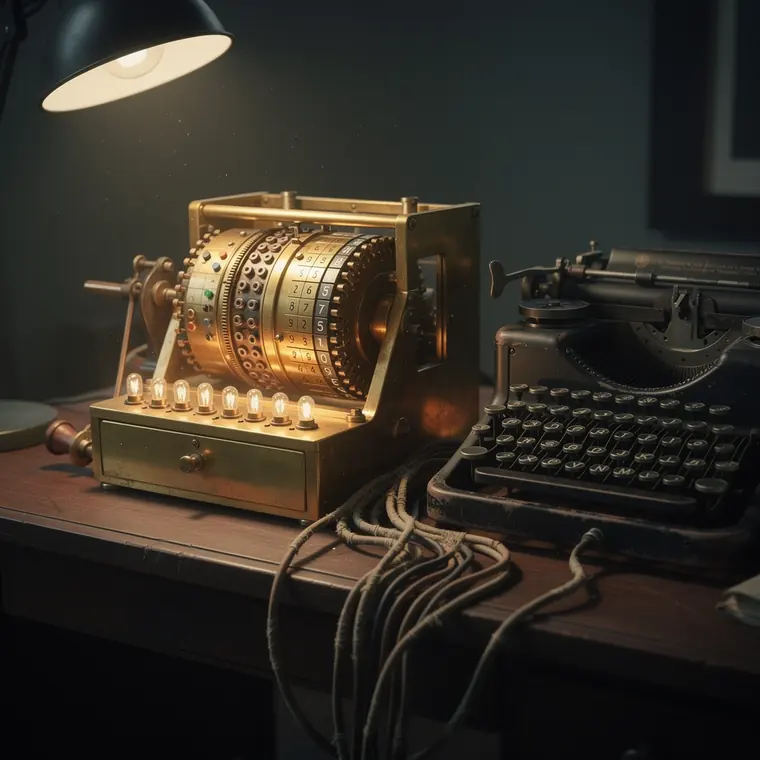
An early American cipher device the size of a cigar box in polished brass, a single coding rotor standing upright in a brass frame with a ring of contacts around its rim, a row of small glow lamps along the front edge, a bundle of cloth-covered wires running from the device to a standard office typewriter standing beside it on the same desk, worn keys and brass contacts catching the light of a single work lamp from above at an angle, the surrounding room falling away into darkness.
- What it was used for
- A rotor cipher machine by the Californian Edward Hebern. The Computer History Museum describes it as "a small typewriter with 26 letters that light up, instead of printing on paper"; the rotor rewired the path between key and lamp and turned one step with each keystroke. Later machines had three and five rotors. The US Navy bought and tested several successive models: in 1925 a small number of five-rotor devices went to the Army and Navy for evaluation, and the Navy bought 36 more over the next six years.
- What was new
- That it was the "first rotor machine" is not certain. The NSA Center for Cryptologic History says Hebern "is generally credited" with the first American electromechanical rotor cipher machine, dates the idea "according to lore" to around 1912 and the working model with filed patent to the end of 1915; the Computer History Museum gives 1917 as the year of the first prototype. The two institutions differ by two years. The museum stresses the form: a cipher device that looked like a small typewriter and was "user-friendly". The barb: by 1921 the company had sold "$1 million in shares" and built a "$386,000" factory designed for 1,500 employees that "never got into full production"; Hebern "ended up back in jail for defrauding his investors". And Friedman solved the machine from test messages whose rotor wiring was withheld from him.
Connections
Every connection names its kind. “Forerunner” on its own would be a claim.
- Parallel toThe Enigma Commercial Machine1923Hebern hit on the electric cipher rotor in 1917 and made a first prototype; the National Cryptologic Museum calls his Electric Code Machine of 1918 the first wired rotor cipher device in the US. In 1918 and 1919 three other inventors in Europe devised the same idea, among them Arthur Scherbius, inventor of the Enigma. The sources report no connection between them.Source: Computer History Museum: Before ENIGMA – Breaking the Hebern Rotor Machine · National Cryptologic Museum: Artifact Catalogue