Schlüsselgerät 41
1944 · SG-41 Pin-and-Lug · Work 460 of 1,871
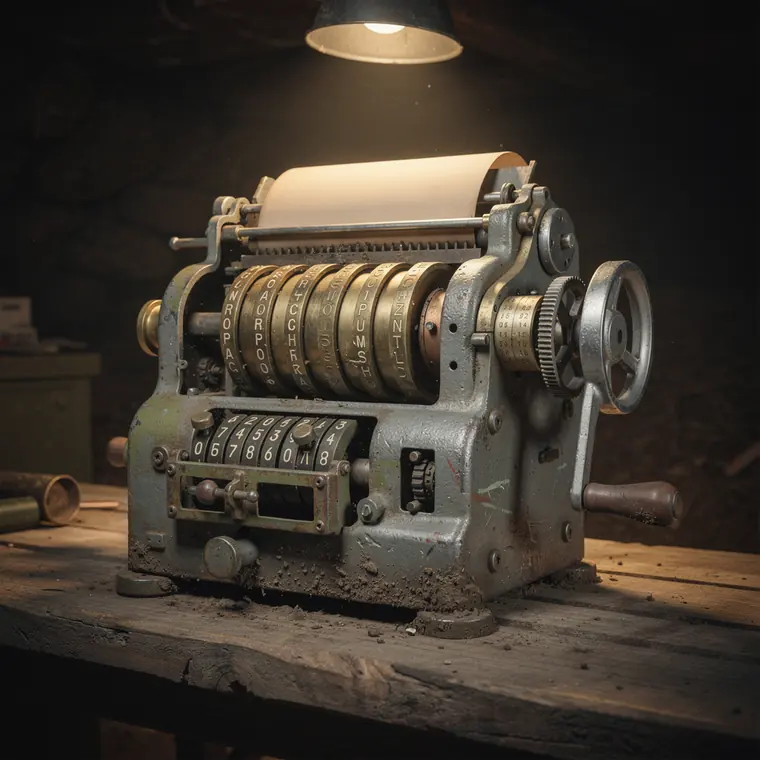
A heavy hand cranked cipher machine in a cast metal case, six irregular pin wheels in a row along the top with different diameters, the four wheels at the left engraved with rings of capital letters and the two at the right with rings of numbers, a paper tape printer at the top with a narrow blank strip, a folding crank at the right side, a character counter at the front left, the whole machine tall and bulky, mud dried in a crust on its base, standing on a rough plank table in a field post, a single lamp from above at an angle, grey cast metal and brass catching the light, the dugout behind in darkness.
- What it was used for
- Intended as the Enigma's successor. It was designed by Regierungsoberinspektor Fritz Menzer and built by the Wanderer works at Chemnitz-Siegmar. The army ordered eleven thousand in 1942; by the end of the war, according to George Lasry, only 1,000 to 1,500 had been produced. It was introduced on 12 October 1944, and only on a few networks of the Abwehr, where it replaced the Enigma G; Lasry names at least three Abwehr links. A numerical version, the SG-41Z, was built in the last months of the war in about 550 units for the Luftwaffe meteorological service, according to the Crypto Museum. It is also known as the Hitlermühle (Hitler mill), most likely after the large crank on its right side. At over 13 kg it was held to be too heavy for the front line.
- What was new
- Inspired by Hagelin's pin-and-lug machines but not a copy of them: Lasry highlights two additions absent from the Hagelin models, the irregular stepping and the complementary kick. The Crypto Museum records that GC&CS read a few messages in depth but did not solve the machine itself, which remained a mystery to them; Lasry cites a report by Walter Fried, the US liaison officer at Bletchley Park, that no generic solution could be devised for messages not in depth. The device that would have posed a real problem for Bletchley came too late, in too small a number, and was too heavy.