The Mansion
1939 · Station X · Work 467 of 1,871
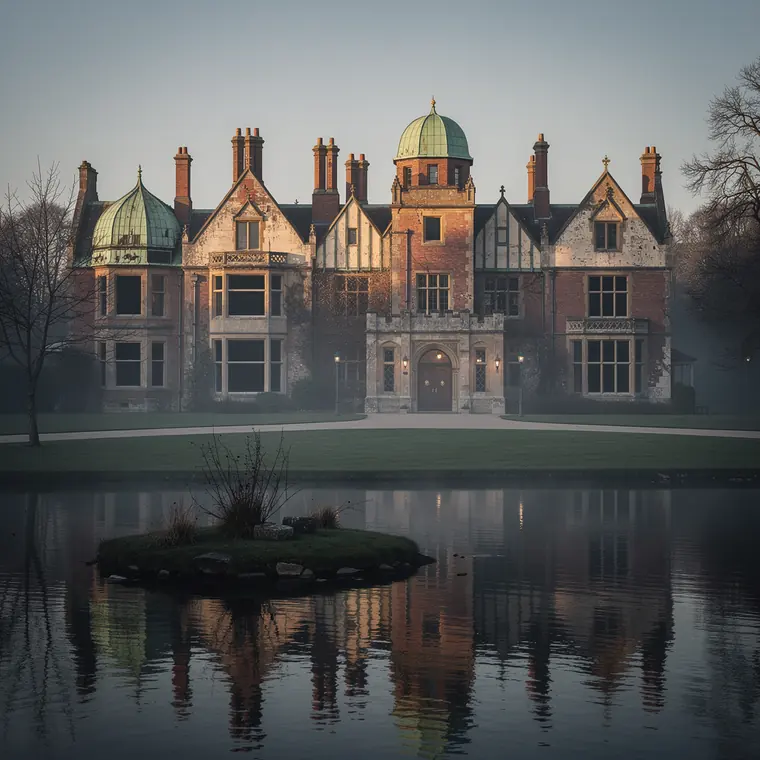
A rambling Victorian country house of mismatched styles seen from across its lake at dusk, the house filling the width of the frame, a copper dome over one wing gone green, gothic and tudor gables meeting on the same roofline, red brick and pale stone mixed, tall chimneys, a gravel drive sweeping up to the entrance, the lake with a small island reflecting the house in the lower half of the frame, an empty lawn of short grass running from the water up to the drive, blackout blinds drawn behind every window, a low warm light on the stone from the west under an open dusk sky and the house otherwise dark, a few bare trees at the edges.
- What it was used for
- From 1939 the mansion was the seat of the Government Code and Cypher School. Historic England lists it as the headquarters building of the Second World War operational centre, in whose grounds stood the hut where Enigma was broken. It has been listed since 10 May 1990, Grade II, list entry 1125409: red brick in Flemish bond with ashlar dressings, principal gables half-timbered with pebble-dashed infill, a Welsh slate roof, two seated griffins on bracketed plinths, and inside panelling, plaster ceilings and a library with a wooden Jacobethan inglenook. The listing names Sir Herbert Samuel Léon and the year 1860, with alterations and extensions of 1883–86 and c1906. The site covered 51 acres.
- What was new
- What was new was not the house but what became of it: a codebreaking works, so compartmented that people in the same hut often had no idea what their neighbour was working on — so David A. Foy describes it in Studies in Intelligence 60/4. Whether Bletchley Park was the first establishment of this kind is not documented. The order of magnitude is documented: Foy, following Tessa Dunlop, gives about 8,500 to 10,000 staff for 1944, with women outnumbering men nearly three to one. They kept silent; when the first books appeared in the 1970s, most veterans, according to Foy, felt it as a betrayal.