The One-Time Pad
1919 · Vernam Cipher · Work 476 of 1,871
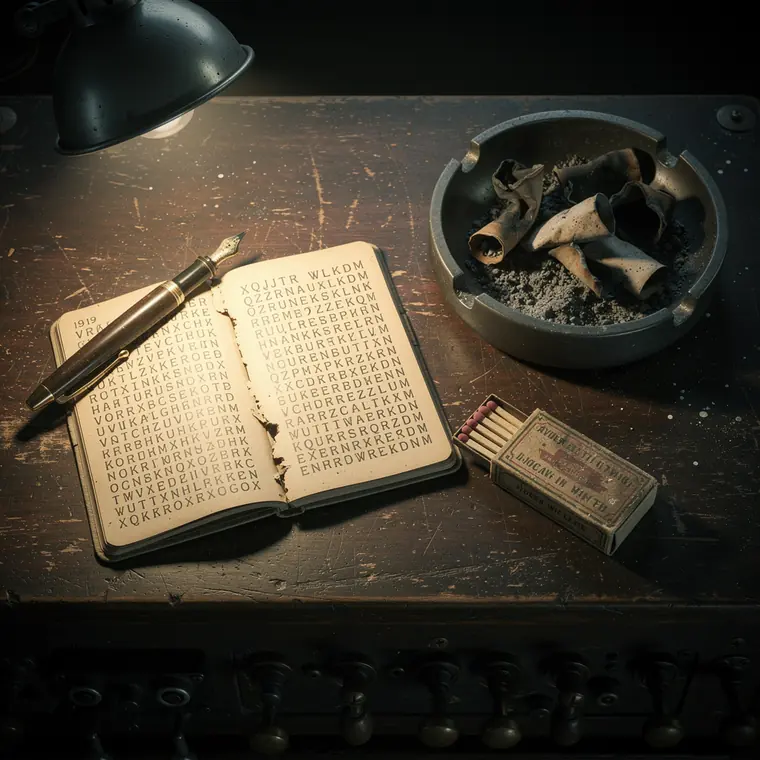
A small booklet of thin paper pages printed with dense blocks of random capital letters in groups of five, a used page half torn out along a perforated edge, a box of matches and a metal ash tray with curled burnt paper and grey ash beside it, a fountain pen, all on a dark wooden desk, a single desk lamp from above at an angle, the thin paper bright and translucent in the light, the room behind in darkness.
- What it was used for
- Gilbert S. Vernam's patent US 1,310,719, "Secret Signaling System", filed 13 September 1918, granted 22 July 1919, assigned to the American Telephone and Telegraph Company. Its stated object: to insure secrecy in transmission, messages being sent in plain characters or a well-known code while the signaling impulses are so altered before transmission that they are unintelligible to anyone intercepting them. Identical sections of tape at both ends of the line carry recorded code signals that are added to the text character by character. Intended for teleprinter traffic over wire and radio.
- What was new
- The patent does not claim what makes the thing unbreakable. None of the 24 claims mentions randomness or single use; the strongest wording is that the rule is changed at frequent intervals or from time to time. The word "random" appears once, in the description, hedged with "preferably" and immediately reopened to a predetermined series of letters or words. Bellovin thinks a cautious attorney quite likely advised against such a claim, as under O'Reilly v. Morse (1854) abstract ideas were not patentable. Who should be credited remains open, and the best source says so itself: Bellovin showed that Frank Miller described irregular shift-numbers, to be erased after use, in 1882, yet holds it quite unlikely that the system was ever used. Kahn credited randomness to Vernam and non-repetition to Mauborgne; Bellovin (2014): non-repetition more likely Vernam, randomness possibly Mauborgne; Vernam's manager Parker insisted on Vernam alone. The proof came only with Shannon in 1949.
Further reading
- US-Patent 1.310.719, Secret Signaling System (Volltext-PDF)
- Steven M. Bellovin, Frank Miller: Inventor of the One-Time Pad (Preprint zu Cryptologia 35/3, 2011)
- Steven M. Bellovin, Vernam, Mauborgne, and Friedman (Columbia Tech. Report CUCS-014-14)
- C. E. Shannon, Communication Theory of Secrecy Systems, Bell System Technical Journal 28/4 (1949)