The Weavers of Lyon
1831 · Jacquard Loom · Work 502 of 1,871
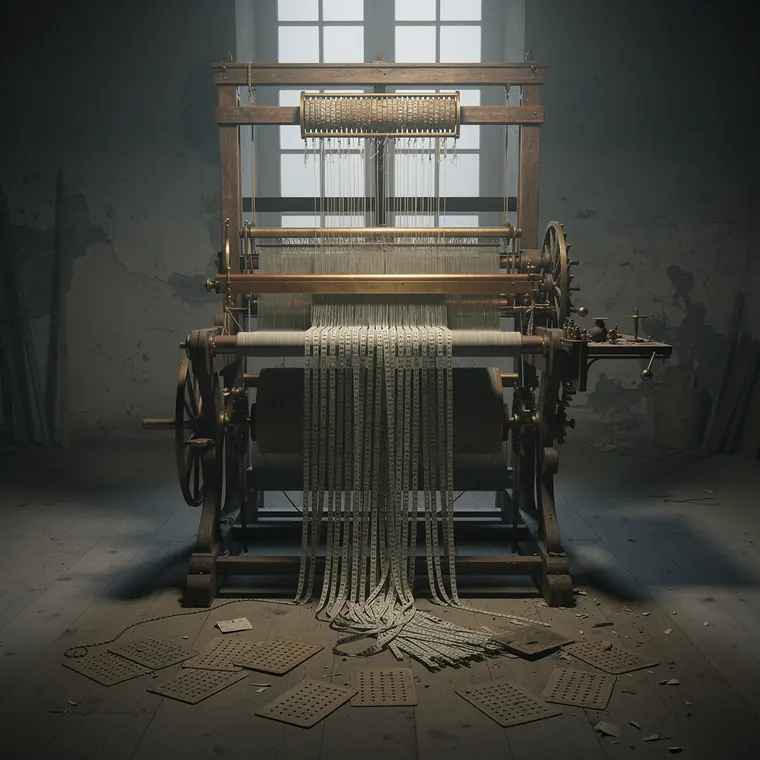
A silk weaver's workshop of 1831, a Jacquard loom with its chain of punched cards cut and hanging loose to the floor, cards scattered across the boards, the harness cords slack, the warp still on the beam, the wooden frame of the loom rising to the ceiling, the card cylinder and needle box at the top of the frame, the floorboards bare, the room in desaturated greys, even flat light from directly overhead.
- What it was used for
- The canuts were the silk weavers of Lyon. They worked not in a factory but in their own dwellings: one large room with four or five windows holding one to four looms, fixed to the ceiling beams because a Jacquard loom stood 3.90 metres high. The merchant (négociant) placed the order and supplied warp and weft, and for figured cloth the punched cards too; the master of the workshop negotiated the piece rate. According to Fernand Rude, cited by Jean-Louis Peaucelle, 1,400 merchants faced 8,000 masters who owned their looms and 30,000 journeymen. That piece rate was what the conflict of 1831 was about. The "tarif" was a minimum-rate schedule: for the taffeta called "gros de Naples" it set 0.60 francs per ell, half of which went to the weaver, who could usually weave four ells a day, so 1.20 francs.
- What was new
- The tariff itself was not new. The canuts had obtained one in 1807, confirmed and extended in 1817; the tulle-makers got one in 1819. It also ran against the law in force: the d'Allarde laws of 1791 forbade any agreement on wages, so the tariff was illegal. Its scope was larger. Before the Revolution one had been proposed for two hundred plain fabrics; the 1831 schedule covered three hundred products in thirty-eight categories. Its main weakness: given the variety of Lyon silks, no schedule could be complete. On 17 November the prefect declared the tariff a mere point of honour with no legal force, and the merchants stopped placing orders. Peaucelle records the outcome: the liberal state won, thirty-eight days after giving way. The fighting cost 170 lives by his figure.
Further reading
- Jean-Louis Peaucelle, Des gouvernements libéraux face à des conflits sociaux, Gérer & Comprendre n°98, Annales des Mines, Dez. 2009
- Musées Gadagne / Musée d'histoire de Lyon, Fiche thématique: Les insurrections des canuts
- Musées Gadagne, Mini-guide La soie
- Millénaire 3 (Métropole de Lyon), Lyon et la soie: la naissance d'une conscience de classe