Shannon's Relay Logic
1937 · Switching Algebra · Work 511 of 1,871
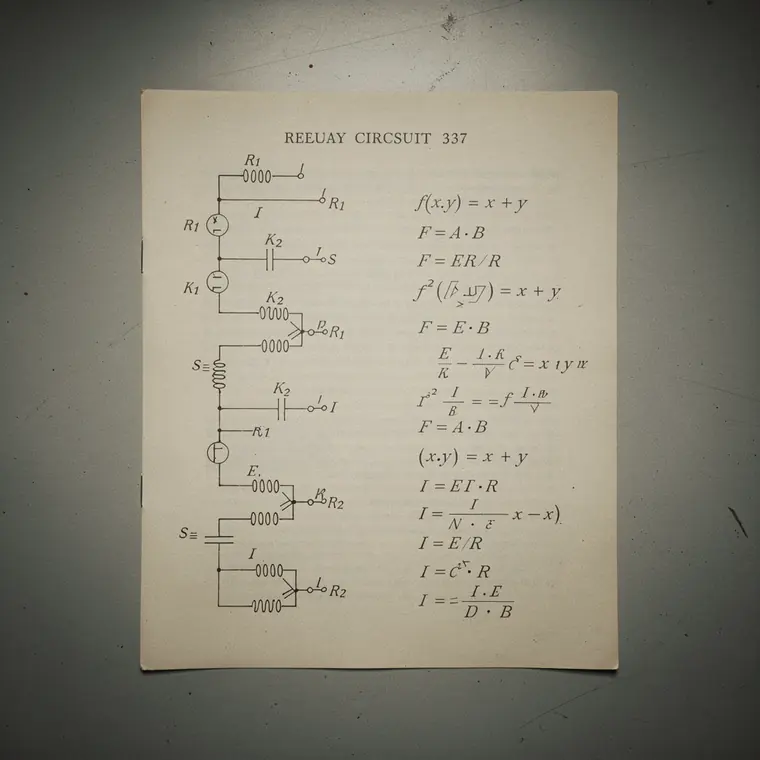
A typescript thesis page of 1937 showing simple relay circuits drawn beside algebraic expressions, two columns matched line for line, the circuits on the left as small schematic switches and coils, the expressions on the right in plain type, the paper cream, the page held flat, each circuit a small closed loop of drawn wire with a switch symbol in it, laid flat on a grey studio table, even flat light from directly above, the page alone in the frame.
- What it was used for
- Claude Elwood Shannon's "A Symbolic Analysis of Relay and Switching Circuits" is a master's thesis at the Massachusetts Institute of Technology, 69 leaves, supervised by Frank L. Hitchcock. The dates belong to different kinds: the author's signature is dated 10 August 1937, the title page gives 1940 as the year of the degree, and MIT catalogues it as a 1940 thesis. Shannon names the field of application on his first page: in the control and protective circuits of complex electrical systems it is frequently necessary to make intricate interconnections of relay contacts and switches, as in automatic telephone exchanges and industrial motor control equipment. He also describes what had been usual until then: a solution obtained by a cut-and-try method, satisfying one requirement after another, seldom the simplest circuit, and often containing hidden sneak circuits.
- What was new
- Shannon states the core himself: a calculus is developed for manipulating these equations by simple mathematical processes, and this calculus is shown to be exactly analogous to the Calculus of Propositions used in the symbolic study of logic. That reverses the direction of work: the desired characteristics are written as a system of equations, the equations are manipulated into the form representing the simplest circuit, and the circuit is then drawn from the equations. In his fifth chapter he demonstrates this, among other things on an adder to the base two. Here too he was not alone: Ioan James writes in his obituary that it was later found that Victor Shestakov at Moscow State University had proposed a similar theory much earlier, though it was not published until 1941. Shannon's zero, incidentally, stands for the closed and his one for the open circuit — the reverse of today's convention.
Further reading
- Claude E. Shannon, A Symbolic Analysis of Relay and Switching Circuits, M.S. thesis, MIT (Originalscan, MIT DSpace)
- Ioan James, Nachruf Claude Elwood Shannon, Bulletin of the London Mathematical Society 46 (2014), S. 435–440
- Information Processing Society of Japan, Computer Museum: Akira Nakashima und die japanische Schaltalgebra