The Kardex Wall
1915 · Visible Record Filing · Work 548 of 1,871
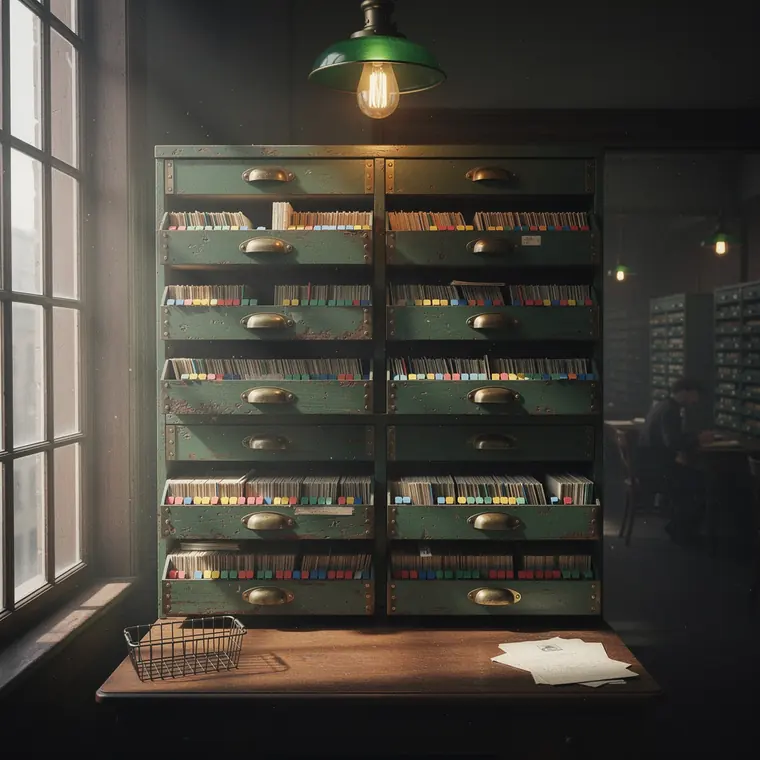
A wall of shallow steel trays stacked in cabinets, several trays pulled out at intervals, each holding cards overlapped so that only the coloured bottom edge of each shows, signal tabs of several colours clipped along the visible margins, the trays green-painted steel with small brass pulls, the cabinets beside a tall window on the left, an electric bulb in a green glass shade hanging above, a flat desk with a wire tray before them, more cabinets and desks running back into the dim office with dark unlit figures at the far desks.
- What it was used for
- Kardex was a card system in which the cards lie flat and overlapping, so that only the written edge of each one stays visible — in drawers, on rotary stands, or in frames on the wall. In 1915 James H. Rand Jr. founded the American Kardex Company to manufacture, in the words of Sperry Rand's own company history, "his own invention, Kardex visible record control system". On 20 September 1924 the trade paper Geyer's Stationer described how the Rand system of the father's firm at Wanamaker's New York store began in accounting and was then extended to other departments; besides the drawer, Rand offered rotary, desk-stand and wall-frame versions.
- What was new
- What was new was that the file could be read without being touched: the edge of each card carried the search term, and a thousand cards made a surface the eye could scan. Visible filing did not begin in 1915: according to the company history, the father, James H. Rand Sr., had already developed the first visible index equipment and founded the Rand Ledger Company to sell it; the son served his apprenticeship there before striking out on his own. The barb is in the company history: father and son joined forces as Rand Kardex in 1925; in 1927 that firm and the Remington Typewriter Company became Remington Rand, which bought the Eckert-Mauchly Computer Corporation in 1950 and delivered the first Univac system to the United States Census Bureau in 1951.