The Quartz Line
1949 · Solid Delay Line · Work 604 of 1,871
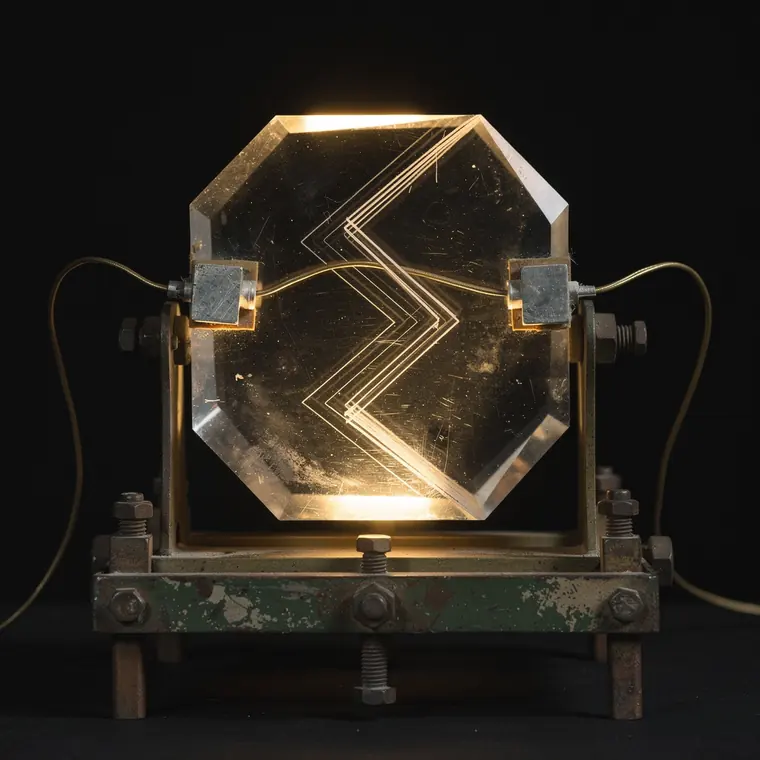
A flat polygonal slab of clear fused quartz, many-sided like a cut gemstone, two quartz crystal transducers bonded to two of its polished faces with fine wire leads, the zigzag acoustic path inside made visible as faint internal reflections folding back and forth between the faces, every edge catching light like the facet of a cut stone, the slab held in a plain metal cradle, seen in extreme close-up so the slab fills the frame, soft backlight passing through the clear quartz and breaking at the edges, the slab alone against pure black.
- What it was used for
- A quartz line is a block of fused quartz through which an ultrasonic pulse travels, usually reflected several times off ground facets, with piezoelectric transducers at the ends. In the early computers, however, quartz was not the medium but only the transducer. The maker Corning Electronics wrote in its 1963 catalogue: "Ultrasonic delay lines were first used for storage purposes in the EDSAC, SEAC, RAYDAC, and UNIVAC I computers. The delay medium used in these early delay lines was mercury" — and: "The transducers were crystalline quartz." Solid lines had, on its own statement, been supplied principally by the same firm "since 1952". Its 1963 catalogue gives fused silica delays of 350 to 1,000 microseconds and up to 25,000 bits per line.
- What was new
- What the solid line could do and mercury could not: it was non-toxic, light and surprisingly low-loss at high frequencies — at 30 megacycles fused quartz "should still be usable without serious attenuation", Engineering Research Associates wrote in 1950. That allowed more bits per line. Fused quartz was indeed more temperature-stable than mercury — Engineering Research Associates gives "1 part in 9,000" per degree against 1 in 3,000 — but not free of it: Corning gives fused silica as −81.5 ppm per degree and offers a heated version for it, while its purpose-developed glass runs at 0 ± 1 ppm per degree. Temperature neutrality came only with the glass, not with the quartz. And the barb is older: mercury had been chosen mainly because it matched the quartz transducer — "the only known liquid with an acoustical impedance comparable to that of quartz is mercury". The poison was a consequence of the crystal.
What the sources leave open: For 1949 no computer with a quartz or glass delay-line store could be documented; Corning's 1963 list of applications names no machine at all. The delay line of PAL colour television is, on F. Th. Backers's 1968 thesis, not quartz but a potash-lead-silicate glass developed for the purpose. Engineering Research Associates contradicts itself in 1950 on the speed of sound in fused quartz.
Further reading
- Glass Memories, Corning Electronics (Corning Glass Works), Katalog RRP 8/63, 1963
- Engineering Research Associates, High-Speed Computing Devices, McGraw-Hill 1950 (bitsavers)
- F. Th. Backers, Ultrasonic delay lines for the PAL colour-television system, Dissertation, Technische Hogeschool Eindhoven 1968