The Torsion Line
1953 · Torsional Delay · Work 606 of 1,871
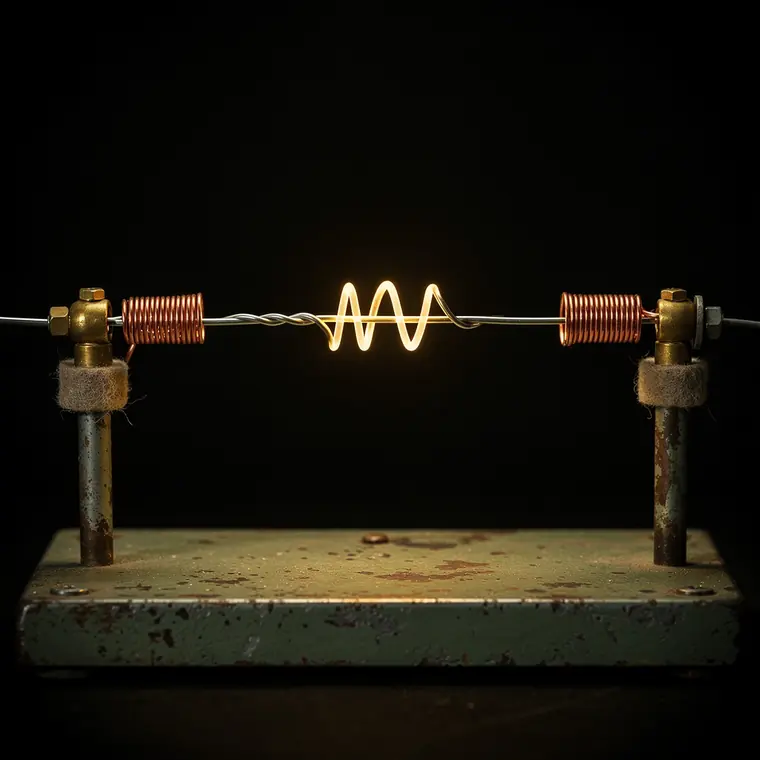
A fine wire held taut between two posts on a plain metal base, a small coil at each end for launching and receiving the signal, a twist travelling along the wire as a visible band of light, the wire caught mid-motion by a strobe flash so a short twisted section shows as a bright helical band while the rest lies straight, small felt pads clamping the wire at the posts, seen in extreme close-up along the length of the wire, the strobe from behind and a single soft light picking out the twist, the wire alone against pure black.
- What it was used for
- In a torsion line the pulse travels through the wire not as a compression but as a twist. That has a solid advantage: the torsional wave is slower, so the same delay needs less wire. Ferranti Electric's 1957 final report for the Air Force Cambridge Research Center sets it out: about "5 microseconds per inch in the longitudinal mode and 9 microseconds per inch in the torsional mode" — a 5-millisecond line therefore needs "500 inches or approximately 40 feet of wire", twice that longitudinally. As the main store of a production computer the type appears in the Ferranti Sirius: 1,000 words in 20 lines of 50 words, extendable to 10,000 words, clocked at 500 kHz. In the Friden EC-130 desk calculator of 1964, 47 feet of Ni-Span C wire lay in 18 turns and delayed by 4.95 milliseconds.
- What was new
- What the torsion line could do and the longitudinal line could not: on Ferranti's 1957 report, torsional waves in a wire of circular cross-section show "no spurious coupling and no dispersion", and the distortion that comes from coiling can be "virtually eliminated by using material which is naturally straight". That naturally straight wire is the core of what Ferranti patented (priority 6 June 1955). The barb is in a competitor's final report: Friden decided against the licence — "Friden did not choose to lease patent rights from Ferranti nor expend money on the development" — and so accepted some dispersion in its coiled wire. A second reversal followed: a temperature-neutral alloy was chosen, and then the nickel transducer ribbons at some 150 ppm per degree brought the temperature dependence back in.
What the sources leave open: For 1953 no torsion-line store could be documented. The earliest documented dates are Ferranti's patent priority of 6 June 1955 and the paper by Scarrott and Naylor in the Proceedings of the IEE of April 1956, whose full text sat behind a paywall. The Sirius prototype is dated 1959 and the deliveries 1960 to 1963.
Further reading
- Ferranti Electric, Inc., Development of an Acoustic Delay Line for Digital Storage, Final Report, Contract AF 19(604)-2041, 1957 (bitsavers)
- Systems architecture of Ferranti Pegasus, Perseus and Sirius, CCS-F3X2, Computer Conservation Society
- Willard E. Wells, Final Engineering Report on the 130 Electronic Calculator Magnetostrictive Delay Line, Friden Inc., 10. Juni 1964
- US-Patent 3,011,136, Electro-acoustic delay-line, G. G. Scarrott / Ferranti, GB-Priorität 06.06.1955
- Ferranti Pegasus, Perseus and Sirius: Delivery Lists and Applications, CCS-F3X1, Computer Conservation Society
- G. G. Scarrott, R. Naylor, Wire-type acoustic delay lines for digital storage, Proc. IEE Part B 103 (Suppl. 3), April 1956, S. 497–508