Palm House Kew
1848 · Curved Wrought Iron Ribs · Work 63 of 1,871
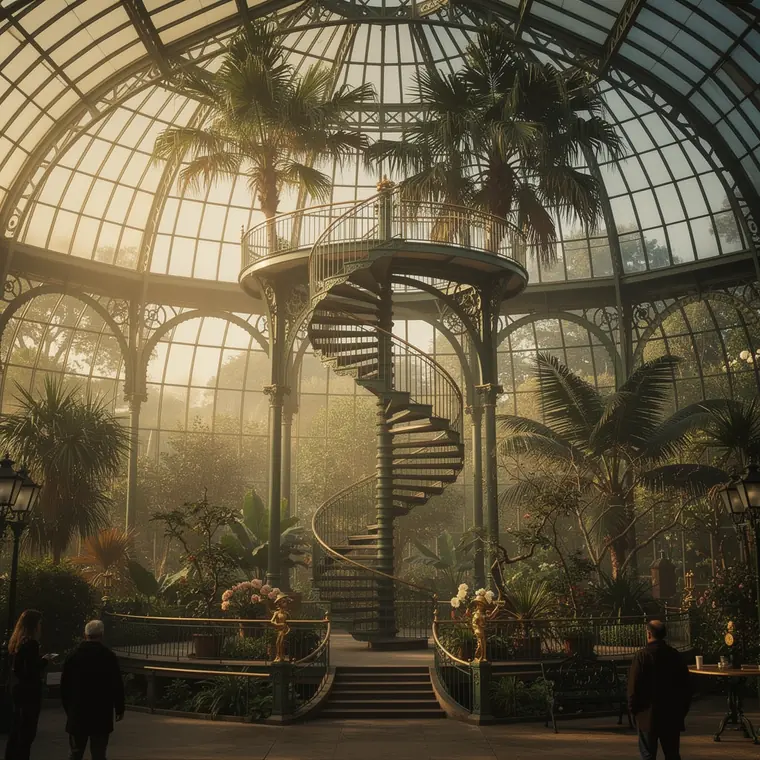
The Palm House at Kew, curved wrought iron ribs shaped by ship-building methods into a glazed hull, a spiral stair rising to the gallery among the palm crowns.
- What it was used for
- Tropical glasshouse of the Royal Botanic Gardens, Kew, finished in 1848. Under the iron grille floor sat twelve boilers with 28,000 superficial feet of heating surface, meant to hold 80 degrees Fahrenheit inside when it was 20 outside. The smoke ran through a 165-metre flue to a chimney that Burton dressed up as an Italian campanile; through the same tunnel men pulled the coal carts by hand. Six permanent staff worked the house in 1848; it cost about 30,000 pounds. Kew was also the Empire's plant exchange: in 1876 Henry Wickham delivered tens of thousands of Hevea seeds from Brazil, and seedlings raised from them went to Ceylon that same summer. By 1908 there were ten million rubber trees in Malaya, and by 1919 Brazil's share of world production had fallen to eight per cent.
- What was new
- The main ribs were made of nine-inch deck beam iron, a rolled section from shipbuilding, welded up to lengths of about 42 feet and bent over a template. The roof, curved throughout, thus spanned some 15 metres without columns at ground level, and the hollow supports doubled as rainwater downpipes. Who first rolled the section is disputed: Grace's Guide gives 1844 and Malins & Rawlinson, on a patent by Kennedy and Vernon; the engineer B. L. Hurst gives 1845 and Mallinson. Turner was not alone: Chatsworth (1840) was wider, though in wood and iron, Turner had built the wings of the Belfast Palm House in 1840, and at Bicton an iron glasshouse of about 1820-25 still stands.
Further reading
- Grace's Guide: Palm House, Kew Gardens (Morning Herald, 15 Jan 1848)
- UNESCO Nomination File 1084, Royal Botanic Gardens Kew (2003)
- Historic England, Listeneintrag 1262670: The Palm House
- Kew: 13 surprising historical facts (Kohlenkarren, Tunnel, Campanile)
- Kew: Secrets of the Palm House (sechs feste Gärtner 1848)
- Kew: Michael Palin on Hooker (Hevea, Malaya, Brasilien 8 Prozent)
- B. L. Hurst, An Iron Lineage, The Structural Engineer 77 (10), 1999