The Ball-and-Disc Integrator
1876 · Mechanical Integration · Work 648 of 1,871
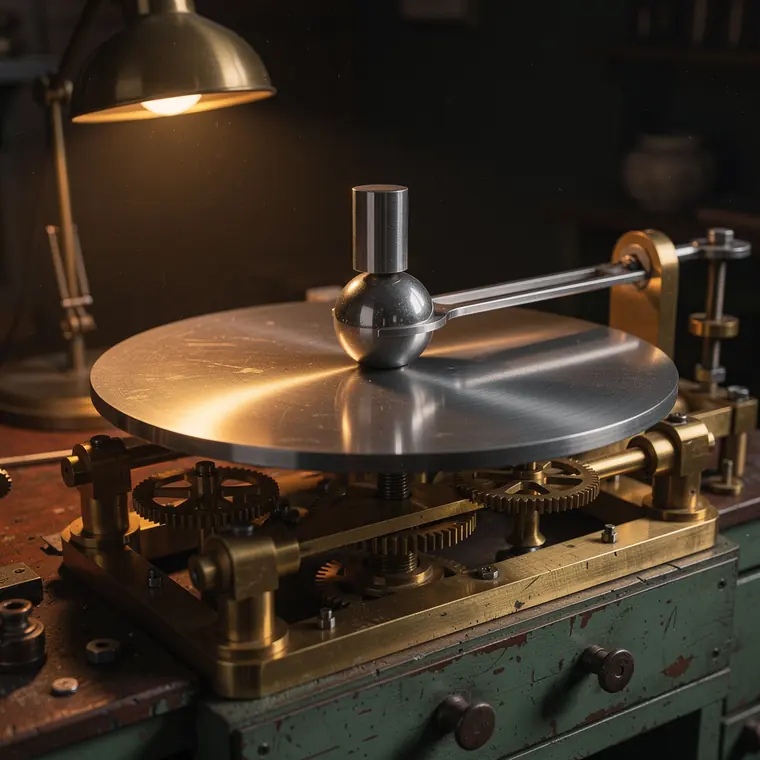
A polished flat steel disc turning horizontally on a vertical spindle, a hard steel sphere resting on the disc and a small polished cylinder resting on top of the sphere, the sphere carried in a light fork that slides along the radius of the disc, its distance from the centre setting how fast the sphere and cylinder turn, the whole mounted on a brass bed with the driving gear of the disc beneath it, the three surfaces of contact lit so their edges glint, in a Victorian instrument maker's workshop, one gas flame at the bench, the workshop walls dark.
- What it was used for
- The disc-ball-cylinder integrator is a gear train that integrates mechanically. A driven disc turns a cylinder through a ball resting on it. Move the ball towards the centre or the rim of the disc and the ratio changes; the rotation of the cylinder is then the integral of the displaced quantity with respect to the rotation of the disc. Unlike the planimeters of Sang and Amsler, whose wheel both rolls and slides sideways, the ball transmits the motion by pure rolling; by James Thomson's own account the idea of pure rolling came from James Clerk Maxwell. James Thomson, an engineer and the brother of William Thomson, published the principle as "On an Integrating Machine Having a New Kinematic Principle" in the Proceedings of the Royal Society. William Thomson built five such integrators into his harmonic analyser of 1878 and refers there to "Professor James Thomson's paper".
- What was new
- Thomson called the novelty a "new kinematic principle" in the title itself: between disc and cylinder sits a ball, not a friction wheel. That turned integration into a component that could be built into larger machines — five times over in one instrument, in William Thomson's case. The barb: the gear train delivers only a very small torque. As long as the ball moved a pointer, that was enough. As soon as the output of one integrator was to drive the input of the next, it was not. Tim Robinson, who builds such machines in Meccano, writes that only the torque amplifier made the first differential analyser possible to build — some half a century later. Bush's 1931 machine then used not balls but wheel-and-disc integrators, a different design.
What the sources leave open: James Thomson's original paper is available as a scan on Zenodo (DOI 10.1098/rspl.1875.0033): Proceedings of the Royal Society, vol. XXIV, pp. 262–265, received 31 January 1876, meeting of 3 February 1876; only the record's metadata give 1875. The type of integrator in Bush's machine is given following the MIT Museum object description.
Further reading
- James Thomson: On an Integrating Machine Having a New Kinematic Principle (Zenodo-Datensatz, DOI 10.1098/rspl.1875.0033)
- William Thomson: Harmonic Analyzer, Proceedings of the Royal Society of London 27 (1878), 371–373 (Transkription)
- Tim Robinson: Torque amplifiers in Meccano
- Vannevar Bush: The Differential Analyzer. A New Machine for Solving Differential Equations, Journal of the Franklin Institute 212 (Oktober 1931), 447–488