The Torque Amplifier
1928 · Servo Amplification · Work 649 of 1,871
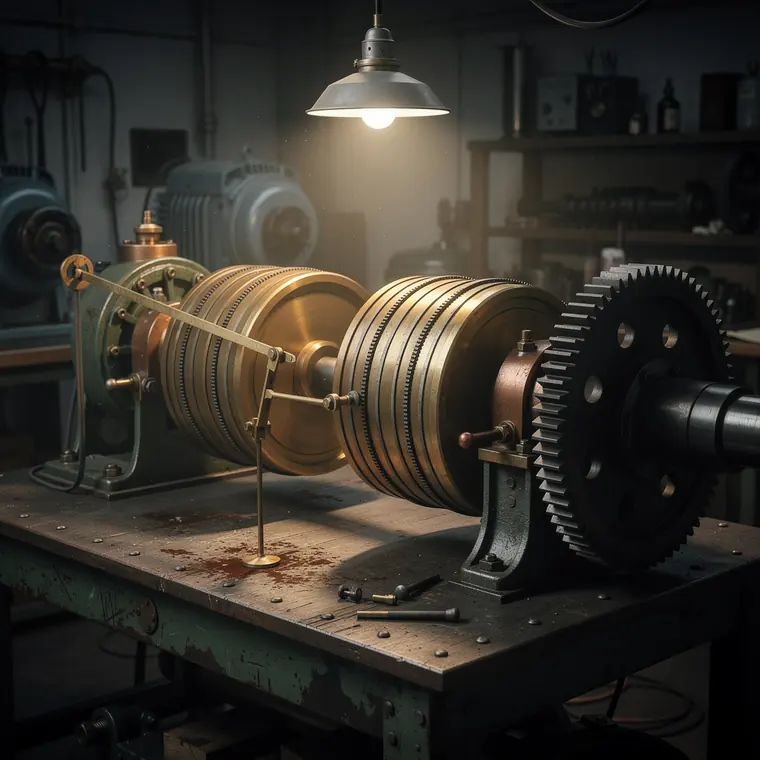
A torque amplifier, two rotating drums side by side each driven by its own belt from a motor, flexible bands wound several turns around each drum in opposite directions, a feather-light input arm touching the end of one band, a heavy output shaft leaving the assembly with a large gear on it, the motor and belt behind, all mounted on a steel bedplate, in an engineering laboratory of the late 1920s, one bare electric bulb overhead lighting the drums, the laboratory beyond in shadow.
- What it was used for
- A torque amplifier is a mechanical amplifier. The output shaft follows the input shaft through the same angle but delivers a far greater torque. Vannevar Bush describes it in these terms in 1931 and gives as its principle friction bands around counter-rotating drums, arranged in two stages, with an amplification ratio of the order of 10,000. It was needed in the differential analyser: the output of one integrator has to drive the input of the next, and the torque of a disc integrator is too small for that. Bush attributes the development of the amplifier to the Bethlehem Steel Corporation and thanks "Mr. Nieman" for his assistance.
- What was new
- What was new, compared with the servo-mechanisms with which Bush's predecessor machine had solved the same task, was an output that followed the input shaft without oscillating. Friction here is not a loss but the source of power: the bands grip drums driven by a motor, and the input shaft only decides how tightly they grip. According to the MIT Museum object description, a paper by C. W. Nieman on torque amplifiers inspired Harold Hazen's work; development of the differential analyser began there in the autumn of 1928. The barb stands in the history of the machine the amplifier made possible. The ENIAC account on the pages of the US Army Research Laboratory calls the mechanical torque amplifier probably the greatest weakness of the differential analyser at Aberdeen: it often failed towards the end of a long trajectory calculation, and the whole calculation was then lost. At the Moore School, Assistant Professor Weygand replaced it with an electronic amplifier.
What the sources leave open: Nieman's own publication was not consulted. For the Bethlehem Steel Corporation's amplifier Bush in 1931 cites journal reports from May 1927 onwards (among them American Machinist 66, pp. 895–897); the year 1928 belongs only to the start of development of the differential analyser, which the MIT Museum places in the autumn of 1928. The spelling "Weygand" is taken over from the ENIAC account.
Further reading
- Vannevar Bush: The Differential Analyzer. A New Machine for Solving Differential Equations, Journal of the Franklin Institute 212 (Oktober 1931), 447–488
- MIT Museum, Objekt IN-2394: Integrator section from Vannevar Bush differential analyzer
- Martin H. Weik: The ENIAC Story (1961), auf den Seiten des US Army Research Laboratory