The Sand Table
1935 · Seepage Model · Work 658 of 1,871
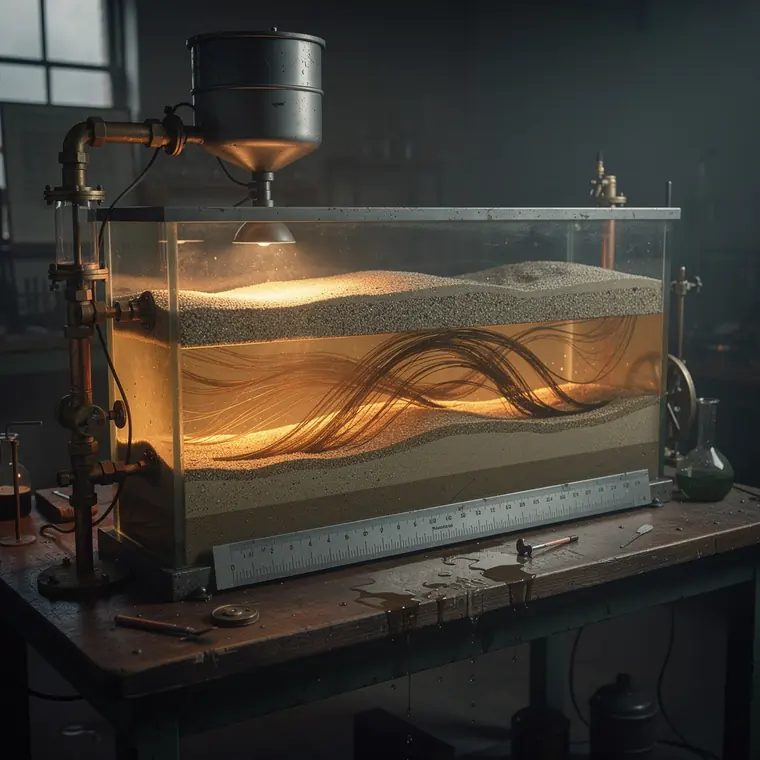
A glass-sided tank of layered sand, layers of coarse and fine sand in bands, dyed water introduced at one end, the flow lines through the layers made visible by the dye as dark curving threads, a scale rule fixed along the outside of the glass with fine graduated tick marks, a water head tank above at one end and an outlet at the other, drips on the bench below, in a civil engineering laboratory of the mid 1930s, one shaded lamp lit close to the glass so the dye threads glow, the laboratory beyond dark.
- What it was used for
- The sand table was a seepage model: a glass-sided tank in which water seeped through sand from an upstream to a downstream pool. Dye grains placed against the glass drew threads that showed the path water takes under or through a dam. Behind it lay a practical question of earth-dam engineering: seepage carries fine particles with it, and where it emerges a dam can be washed out from inside. Arthur Casagrande stands for the role of such work. The article on the early history of geotechnics in History of Geo- and Space Sciences reports that in 1935 he added a course on seepage in soils to the Harvard programme, and describes the Franklin Falls Dam case in New Hampshire: his analysis showed serious leakage problems that could threaten the integrity of the dam, remedied with an upstream blanket and a deep trench. In 1937 he published "Seepage through Dams" in the Journal of the New England Water Works Association.
- What was new
- What the model showed is also a method of calculation: the visible flow paths are the flow lines of the flow net, a grid of flow lines and lines of equal potential from which the seepage quantity and the water pressure inside a dam can be estimated. C. I. Sachpazis writes that the method was "initially set out by Forchheimer, 1900, and later refined by Casagrande, 1937", and quotes Casagrande's 1940 rule that flow lines and equipotentials should always be perpendicular to each other. The barb: on Sachpazis's account the net is sketched by hand, by trial and error.
What the sources leave open: Thin. No contemporary laboratory report on any particular sand table was consulted; Casagrande's 1937 paper is documented only through citations. For the year 1935, only the Harvard seepage course is documented, not a device. Neither source gives figures for seepage quantities or model dimensions.
Further reading
- Contribution to the knowledge of early geotechnics during the twentieth century: Arthur Casagrande (History of Geo- and Space Sciences 9, 2018, 107ff.)
- C. I. Sachpazis, Experimental Conceptualisation of the Flow Net System Construction inside the Body of Homogeneous Earth Embankment Dams (EJGE 19, 2014)