The Operational Amplifier
1947 · Electronic Analogue · Work 671 of 1,871
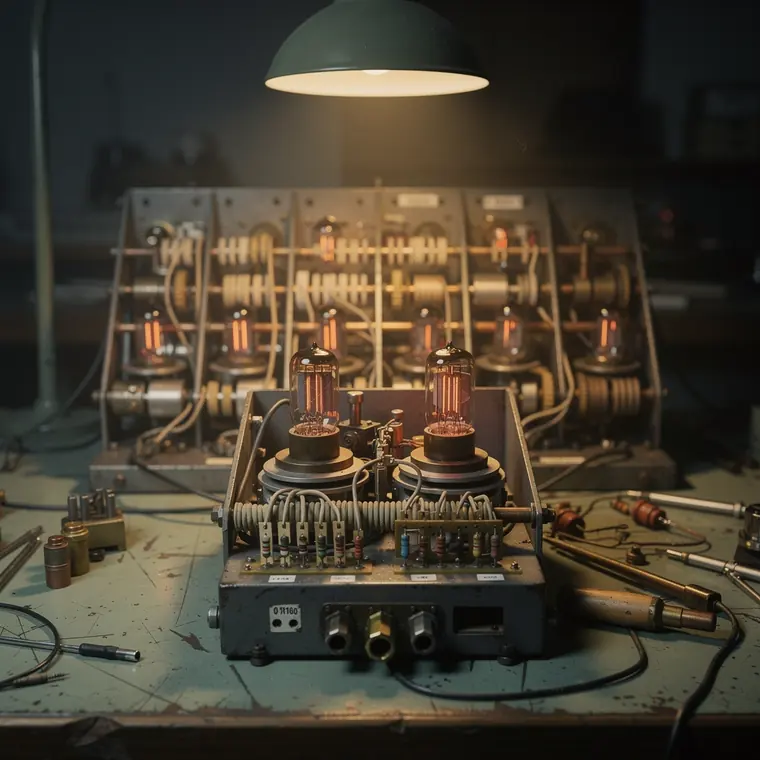
A plug-in module of two vacuum tubes and a handful of precision resistors on a small chassis with an octal plug at its base, a module which will integrate, add or invert depending on what is wired around it, a rack of identical modules behind stepping into depth each with its two tubes glowing, resistors on tag strips, the chassis plain, on a laboratory bench, in an electronics laboratory of the late 1940s, one lamp lit over the module so the tube heaters glow orange, the laboratory beyond dark.
- What it was used for
- The operational amplifier is an amplifier of very high gain whose behaviour is set not by its tube but by its feedback. Which resistors and capacitors are wired around it decides whether it adds, multiplies by a factor, integrates or differentiates. In that role it was the computing element of the electronic analogue computer: an integrator turned a velocity into a distance, a summer combined forces, and from such blocks came, for instance, the computation of a gun director, then the main application of such computers. It acquired its name in a paper by John R. Ragazzini, Robert H. Randall and Frederick A. Russell, Analysis of Problems in Dynamics by Electronic Circuits, published in the Proceedings of the IRE, volume 35, May 1947, pages 444 to 452. The name was justified on the ground that the circuit, together with other components, can perform mathematical operations.
- What was new
- The circuit itself was not new. Feedback amplifiers had been known since the 1930s, and Bell Laboratories were already using summing amplifiers in gun directors to compute firing angles. What was new was the step to a building block: the 1947 paper treated amplifier, integrator, differentiator and summer not as four devices but as one device with four external networks. The computing element was thereby separated from the computing task, and amplifiers could be bought instead of designed. The figure for that: the K2-W, put on the market by George A. Philbrick Researches in 1952, cost about 22 dollars, and the Computer History Museum timeline calls it the Model T of the operational amplifier because one no longer had to design one oneself.
What the sources leave open: The bibliographic details come from the faculty page of Columbia University, where Ragazzini taught. The original publication was not consulted, so the exact wording of the naming has not been verified and is not quoted here.