The National Register
1939 · National Registration Cards · Work 707 of 1,871
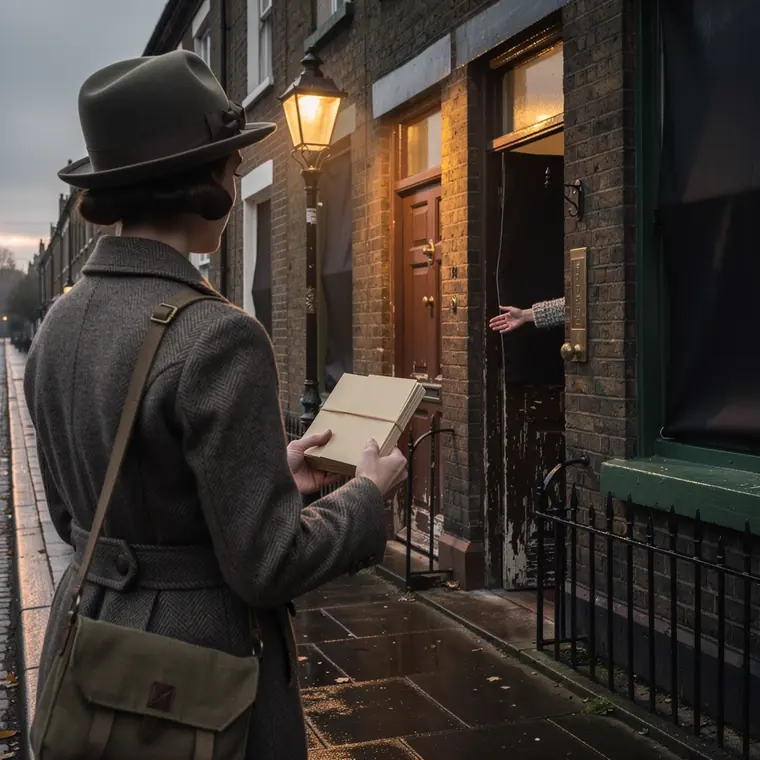
The front door of a brick terraced house in a street in England at dusk in the autumn of 1939, the windows of the whole terrace already covered from inside with black blackout cloth, a woman enumerator seen from behind in a belted tweed coat and felt hat, a khaki canvas satchel on a strap over her shoulder, in her hand a small stack of folded cards of plain buff card held together by a rubber band and seen from the edges, the door open by ten centimetres, in the gap a single hand in a knitted cardigan sleeve, wet paving stones, a cast-iron street lamp with its lantern glass masked in black paint, last grey daylight.
- What it was used for
- The National Register was the list of every civilian in Great Britain and Northern Ireland. It was compiled on 29 September 1939, National Registration Day, proclaimed by Registrar General Sir Sylvanus Vivian. Everyone from infant to the very old was to be recorded, foreigners and visitors included, but not serving members of the armed forces apart from those on leave. For England and Wales, the registration authorities recruited 65,000 enumerators to check the entries with households on the doorstep. Each person received a National Registration Identity Card with a number of their own. The household forms went to the Food Offices, which made up the ration books from them. Findmypast states that forms were issued to over 41 million people.
- What was new
- What was new was not that a state listed its inhabitants. What mattered was what the number could do. It was not serial but constructed: The National Archives describes the format ABCD 123:4 as area code, enumeration district letter, household number and position within the household. From the number alone one could therefore read which household a person lived in and their place in it. And it was tied to food from the start, because rationing was built on the same form. The sting lies in the duration. The register and the duty to carry a card were wartime measures, and the legal requirement to carry the cards ended in 1952. The numbers did not: in 1948 they became NHS numbers and, in The National Archives' account, remained in use into the twenty-first century.
What the sources leave open: The National Archives blog names no statute and no date of passage. Findmypast states that the National Registration Act received royal assent on 5 September 1939. Neither page gives a final count of persons registered. Findmypast gives only the over 41 million forms issued.