The Enumerator's Badge
1960 · Census Taker's Credential · Work 713 of 1,871
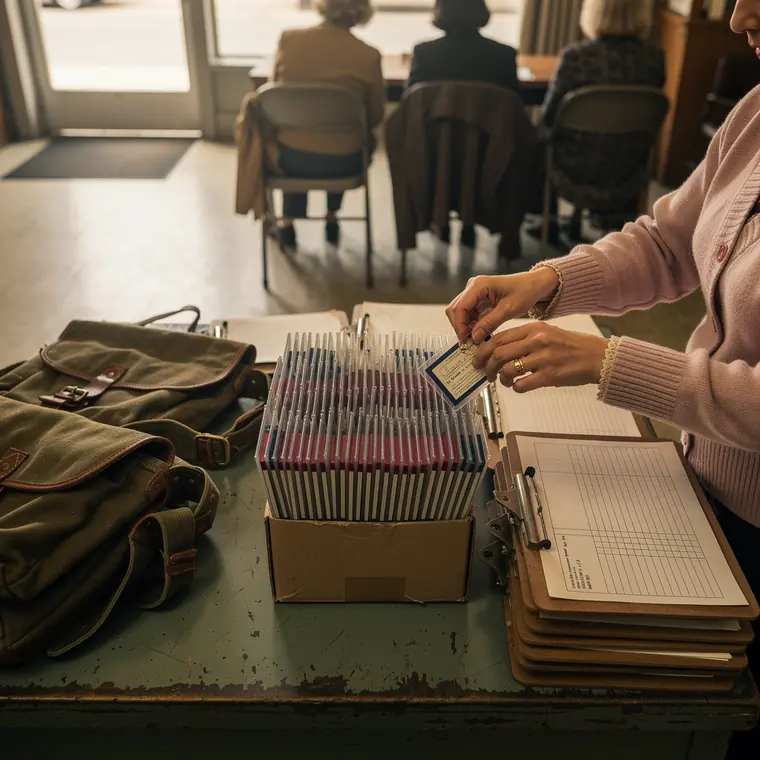
The issuing table of a district census office in an American town in March 1960, in the foreground an open shallow cardboard carton holding several hundred small identification cards in clear plastic holders standing upright on their long edges in tight rows, seen from above and along the rows so that only their top edges show as fine stripes of dark blue, cream and red, each holder with a small steel safety pin on its back, beside the carton a pile of canvas satchels and a stack of clipboards with sheets as a pale grid of lines, the hands of a woman clerk in a pastel cardigan lifting one holder by its pin with its back toward the lens, behind the table folding chairs with coats over them and a row of waiting women and men seen from behind, linoleum floor, daylight from a storefront window.
- What it was used for
- The badge identified the enumerator at the door. According to the Census Bureau the postal service delivered the questionnaire to every occupied housing unit in 1960; the household filled it in and held it for the enumerator to collect. The second stage, the long form for one household in four, was hand-delivered and mailed back in postage-paid envelopes; in thinly settled areas both stages fell into a single visit. For vacant units the enumerator completed the form himself. The count recorded 179,323,175 residents and cost, according to the Bureau's own facts page, $127,934,000, or 71.4 cents per capita.
- What was new
- What was new was the job behind it: in 1960 the wearer appeared mainly as a collector and checker rather than as a questioner, because the household had already filled in the form. According to the Census Bureau, 1960 was the first census in which the forms reached households by mail in advance; self-enumeration had been used before only on a limited scale. The barb lies in the Bureau's own figures: its caption to the badge says "more than 144,000" enumerators, while the same agency's facts page for the 1960 census gives 159,321. That is a gap of some 15,000 people between two publications of one office about one census.
What the sources leave open: The sources name no innovation in the badge itself.