The Exchequer Tally
1822 · Split Tally Sticks · Work 721 of 1,871
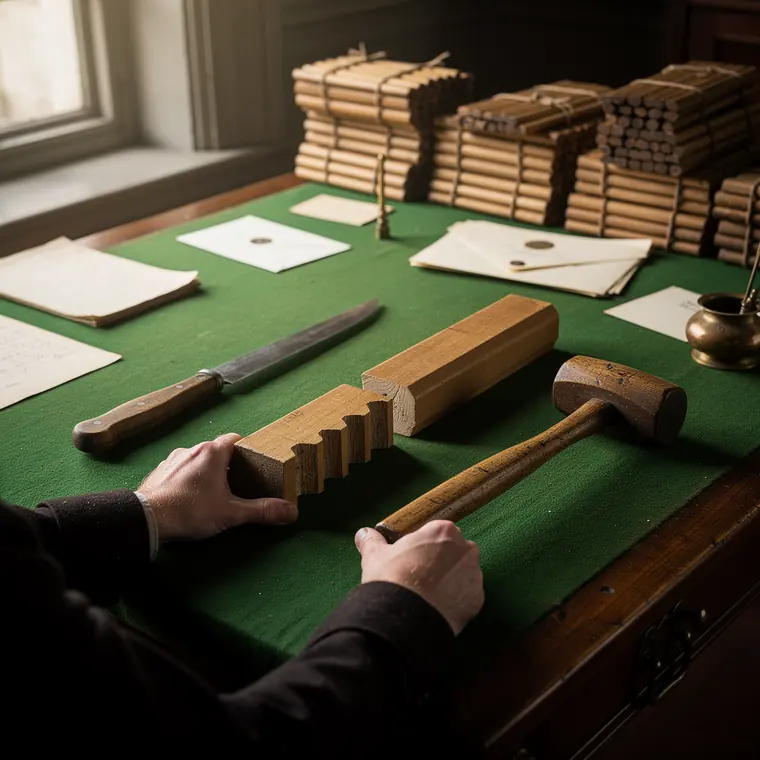
Two split wooden tally sticks of 1822 on a green baize table in a writing room of the treasury at Westminster in London, the longer stick fifty-eight centimetres long, the shorter forty-six, each three centimetres wide and one thick, squared honey-brown wood, the split faces pale and fibrous, a row of broad rounded notches at one end giving a wavy edge, the longer stick keeping its full square section as a handle, beside them a short broad knife and a wooden mallet, against the back wall bundles of similar sticks tied with cord, two hands in dark woollen sleeves laying the halves together, daylight from a window on the left.
- What it was used for
- A split tally of the English Exchequer, made in London in 1822 and held by the Science Museum as 1860-30. It served as a receipt for money paid in. The object is in 2 parts: the longer stock, 580 millimetres, and the shorter foil, 465 millimetres. The size of the sum lay in the notching - according to the Science Museum, differently spaced notches stood for a penny, a shilling, £1, £20, £100 and £1,000. The same source states that the Exchequer used such tallies from the middle of the 12th century until 1826.
- What was new
- Nothing about this piece is new, and that is its value: in 1822, 4 years before the end of the procedure, the English Exchequer was still cutting its receipts in wood, some 670 years after the practice began. The barb is in the UK Parliament's own account: after the tally system was abolished in 1826 about 2 cartloads of tallies were left behind, and the Clerk of Works's decision to burn them in the furnaces rather than in the open or give them away as firewood led to the fire of 16 October 1834. A receipt system made of wood destroyed the building that housed it.
What the sources leave open: The Science Museum catalogue gives neither the sum this tally records nor how stock and foil were checked against each other; only the split and the notch values are documented.