The Automatic Sovereign Balance
1842 · Automatic Coin Weighing · Work 722 of 1,871
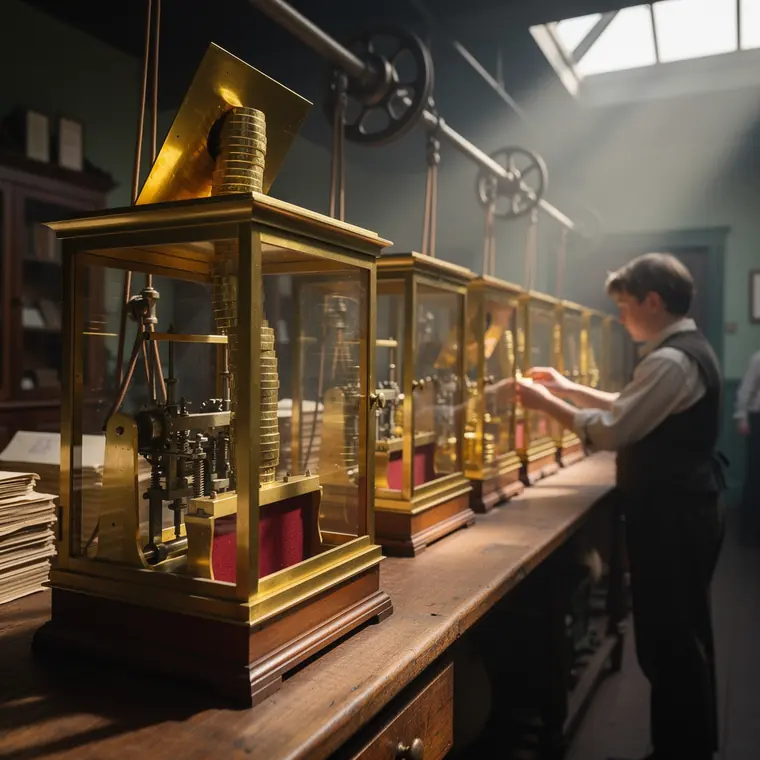
A row of small automatic coin weighing machines of 1844 on a long oak bench in the weighing room of a bank in London, each a glass case twenty centimetres wide and seventeen high on a moulded mahogany base, frame and top plate of golden yellow brass, on each top plate a slanting open brass chute holding plain gold discs seen edge-on in a column, inside the nearest case a fine balance beam and a channel lined in red, thin leather cords running from each case up to a line shaft under the ceiling, a boy seen from behind in a waistcoat feeding a chute, even light from a skylight.
- What it was used for
- A balance that weighed gold coins one by one and sorted them by weight; at the Bank of England it determined the weight of the coins passing through. It was built by the firm Napier & Son; according to Helen Small's 2020 article it rested on an invention by William Cotton. The Napier Power Heritage Trust writes that work began in 1842, that a prototype went to the Bank for testing and that "the following year they purchased three machines", and that Napier machines were also used by governments and mints abroad. The Science Museum holds a Napier machine for weighing and classifying gold coins, dated 1853, as 1961-101, credited to the Bank of England.
- What was new
- What was new was that the verdict on the single coin - light or good - was reached mechanically and that the machine separated the pieces itself. The barb is the long run-in. The Napier Power Heritage Trust dates the Bank's purchase of 3 machines to the year after 1842. Helen Small writes that improved machines were introduced at the Bank in 1851 at the request of John Herschel, Master of the Mint, and entered regular service only in 1866 after a decade of refinement. From the start of development in 1842 to regular use in 1866, 24 years passed; the Science Museum's example of 1853 dates from that period.
What the sources leave open: None of the sources gives a working speed.
Further reading
- Early Napier Products and Machines - Napier Power Heritage Trust
- Helen Small, Artificial Intelligence: George Eliot, Ernst Kapp, and the Projections of Character (2020), Abbildung: Napier & Son, 'Automaton' coin weighing machine for the Bank of England, 1842
- Napier machine for weighing and classifying gold coins, 1853 (1961-101), Science Museum Group Collection
- Helen Small, Artificial Intelligence: George Eliot, Ernst Kapp, and the Projections of Character, 19: Interdisciplinary Studies in the Long Nineteenth Century 29 (2020)