The Time Lock
1874 · Clockwork Vault Lock · Work 724 of 1,871
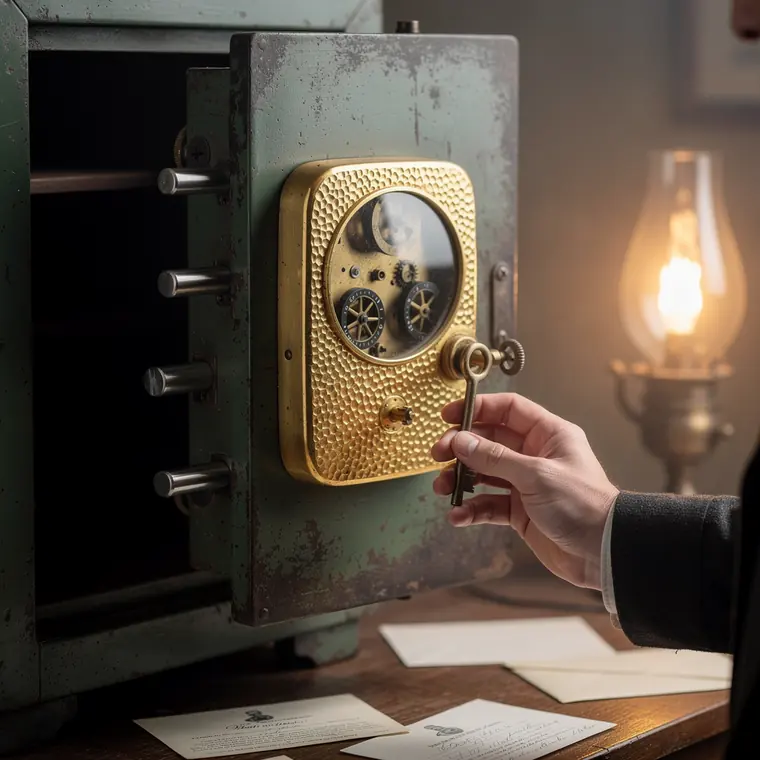
A time lock of 1874 mounted on the inner face of the open steel door of a safe in a small-town bank in the American Midwest, a flat, nearly square metal case seventeen centimetres high, twenty wide and seven deep with rounded corners, its whole cover bright fire-gilt gold with an irregular crystalline hammered texture, in the cover a large flat glazed window, wide across the top and narrowing in a curve toward the bottom, behind the glass side by side two small round black rings around open spoked brass wheels, small, at a slant, polished steel bolt bars on the door, a hand in a dark sleeve holding a small winding key at the case, warm kerosene lamplight from the right.
- What it was used for
- A lock on a bank vault door that cannot be opened before a set hour, not even with the right combination. The collector account at my-time-machines.net, which cites John and David Erroll, American Genius. Nineteenth Century Bank Locks and Time Locks, gives for 1874 the Model 1 in small numbers, combining a combination lock with a time lock, and the Model 2, the first stand-alone time lock by Sargent & Greenleaf, first used in 1874 on the vault door of the First National Bank of Morrison, Illinois. The same source names the occasion as the bankers' dilemma: in the late 1860s and early 1870s robbers kidnapped the holder of the combination after hours and forced him to open the safe, and effective alarms did not exist, above all in small towns.
- What was new
- What was new was not secrecy but its inversion: the time lock protected the money by making the bank's own people powerless. According to the same source the combination could now be known to several employees, because outside the set hours nobody could open the door - coercion lost its point. Sargent did not invent the time lock, even though the Sargent & Greenleaf company history credits him with inventing and patenting the first bank vault time lock in 1872: according to the history of the time lock industry at my-time-machines.net, Francis Pye exhibited one at a fair in New York in 1851, and Amos Holbrook's lock of 1858 ran for 8 years at the Milford Bank in Massachusetts.
What the sources leave open: The company history gives no patent number for 1872. The patent dates of 1875 to 1877 shown at my-time-machines.net are on bolt plaques of later locks and do not contradict 1872 or 1874.