The Automatic Cashier
1899 · Keyboard Change Dispenser · Work 727 of 1,871
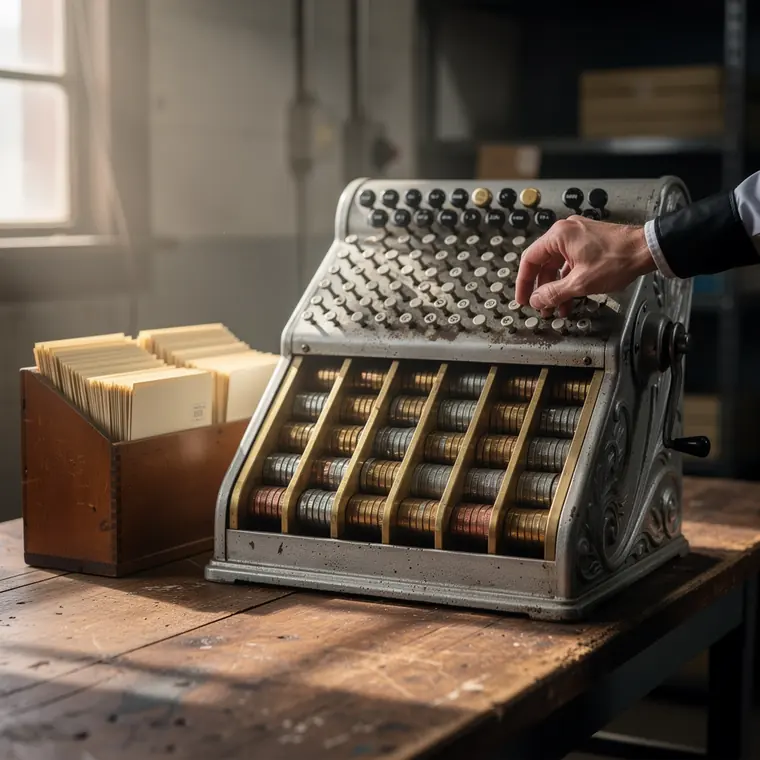
A change-making machine on the paying table in the wage office of a railway workshop in the American Midwest in 1925, a desk machine twenty-eight centimetres high, twenty-four wide, of silver-grey cast metal with scrolling relief ornament on the sides, across the front eight open slanting coin channels with brass-coloured dividers, each holding a column of plain coins seen edge-on, behind them a rising field of small round key tops seen at a slant as dark and pale dots, one hand in a black sleeve protector on the keys, beside it a wooden box of brown pay envelopes on edge, plain backs to the lens, window light from the left.
- What it was used for
- The Brandt Automatic Cashier dispensed change between 1 and 99 cents. It was invented by Edward J. Brandt, a cashier at the Bank of Watertown, Wisconsin, and built by the Brandt Manufacturing Company of Watertown. Eight coin channels - 3 for pennies, 1 for nickels, 2 for dimes, 1 for quarters, 1 for half dollars - were worked by 99 numbered keys: pressing key 5 released 5 cents, with further keys for 10, 25 and 100 cents. The Smithsonian gives the background: American workers were paid in cash and making up the pay packets was laborious. The Postal History Foundation describes machines placed in post offices and suspects, from the cast mark "P.O.D." on its example, an original from the era of the postal scandals around 1900.
- What was new
- What was new was not paying out money but that the arithmetic moved into the keyboard: the teller chose the sum, the machine decided which coins to build it from, and according to the Postal History Foundation it also detected slugs. The brass plate on the Smithsonian's example cites patents of 11 July 1899 and 12 December 1916; medals followed at the world's fairs in Paris 1900 and St. Louis 1904. The price of that relief was one key per sum: 99 keys for 99 amounts. The machine took away the counting, not the aiming.