Reliance Building
1895 · Steel Frame with Terracotta Cladding · Work 73 of 1,871
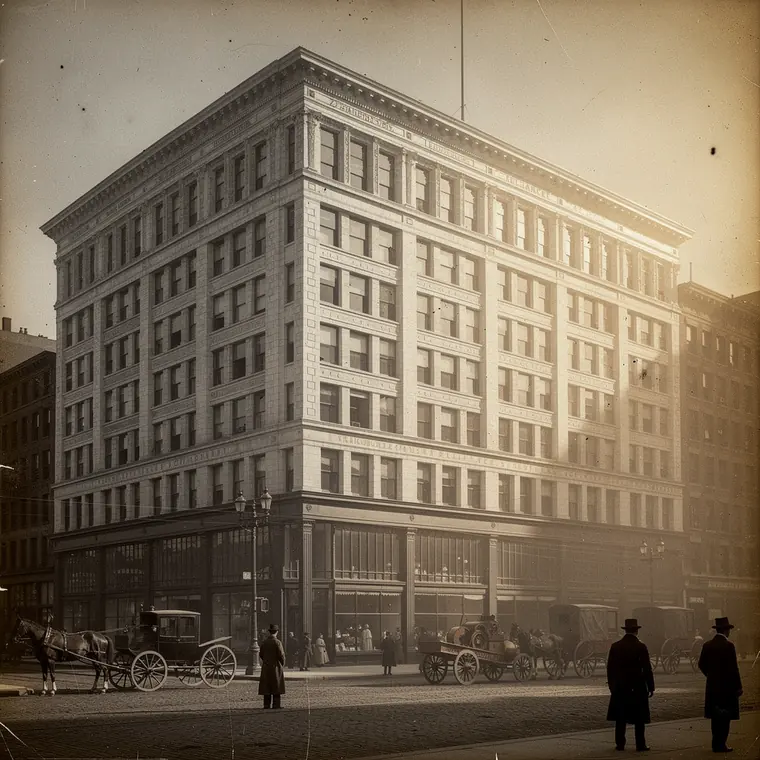
The Reliance Building in Chicago, its steel frame sheathed in white glazed terracotta, projecting Chicago windows stacked in bays from pavement to cornice, narrow piers between continuous glass, plate glass shopfronts at street level, the street before it carrying only horse-drawn carriages, delivery wagons and pedestrians in long coats and hats.
- What it was used for
- The client was William E. Hale, a manufacturer of hydraulic and steam elevators - he sold in his own building the technology that makes tall buildings usable. Because the leases on the upper floors ran to 1894, the ground floor and foundations were replaced first, in 1890, while the upper storeys and their tenants stood on jack screws; the superstructure followed in 1894-95. Carson, Pirie, Scott sold on the ground floor; the upper floors were planned from the outset for doctors and dentists. By 1920 the building had over 300 tenants, all in medical services, with consulting rooms let by the hour. After the Depression it emptied; in 1994 the City of Chicago bought it and spent $6.7 million on the exterior. Since 1999 it has been a hotel with 122 rooms.
- What was new
- Not a first skeleton frame: the National Park Service landmark nomination explicitly calls the building a refined version of an earlier Chicago type, Holabird and Roche's Tacoma Building. What was new was the ratio. The outer walls no longer carry any load, the iron skeleton carries everything, and the facade is almost entirely windows, in bands between very narrow piers and mullions of glazed terracotta. The speed that followed from this is the real figure: the top ten storeys went up in 15 days, from 16 July to 1 August 1894, less than two days per floor (the landmark nomination prints 1895, contradicting its own chronology). The glazed terracotta, which the rain was supposed to keep clean, was partly replaced in the 1990s restoration; the cornice had already been removed in 1948.