Ditherington Mill Facade
1797 · Cast Iron Internal Frame · Work 75 of 1,871
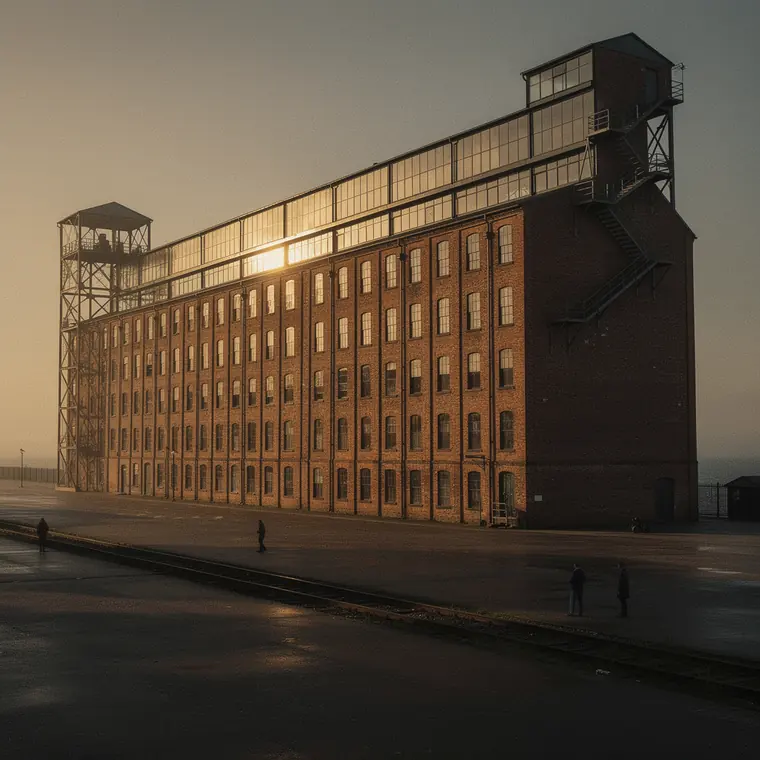
Ditherington Flax Mill in Shrewsbury seen from the yard, five storeys of small iron-framed windows in a long brick elevation, the stair tower rising at one end above the roofline.
- What it was used for
- A flax mill near Shrewsbury, built from 1796 by the merchants Thomas and Benjamin Benyon together with John Marshall, in production from 1797. The whole route from raw flax to linen yarn sat under one roof, driven entirely by steam, at first by a 20 hp Boulton and Watt engine. In the early 19th century over 400 people worked here, more than half of them women, more than a third children under 16; workhouse apprentices lived in the Apprentice House on site. Gas lighting from 1811 made round-the- clock working possible. The business failed in 1886. In 1897-98 the building became a maltings - and the unusually large windows, for which the iron frame had made room, were bricked up. It stood as a maltings for 90 years, as a spinning mill for 89.
- What was new
- Historic England words its list entry precisely, and the wording is worth keeping: the first building in the world to replace successfully the timber beams and joists used in industrial buildings up to that date with incombustible materials, namely cast and wrought iron and brick. So not a first framed building - the same entry records that the brick walls carry part of the floor load and that wooden trusses sit above the brick vaults. The precursor stood in Derbyshire: from 1792-93 William Strutt had put cast-iron columns under plastered timber beams at Derby, Milford and Belper. Charles Bage replaced the beam with cast iron as well. Strutt took that up in 1804 when he rebuilt Belper North Mill.
Connections
Every connection names its kind. “Forerunner” on its own would be a claim.
- Follows fromWatt Rotative Engine1788Historic England names the engine by type: a "Boulton and Watt 20hp rotary condensing beam engine", installed in 1797 in the engine house at the south end of the mill. Through a vertical shaft it drove the line shafting of every floor, from which the spinning machines were belted.Source: Historic England, National Heritage List 1270576: Shrewsbury Flaxmill Maltings, Spinning Mill · English Heritage: History of Shrewsbury Flaxmill Maltings
Further reading
- Historic England, National Heritage List 1270576 (Spinning Mill, Ditherington, Grade I)
- English Heritage: Shrewsbury Flaxmill Maltings, History
- Historic England, Heritage Calling: The First Skyscraper (Belegschaftszahlen)
- Oxford Archaeology: Ditherington Flax Mill, Watching Brief Report
- Derbyshire HER MDR7742 (Belper West Mill) / Grace's Guide: William Strutt