The Facer-Canceler
1963 · Ultraviolet Stamp Detection · Work 750 of 1,871
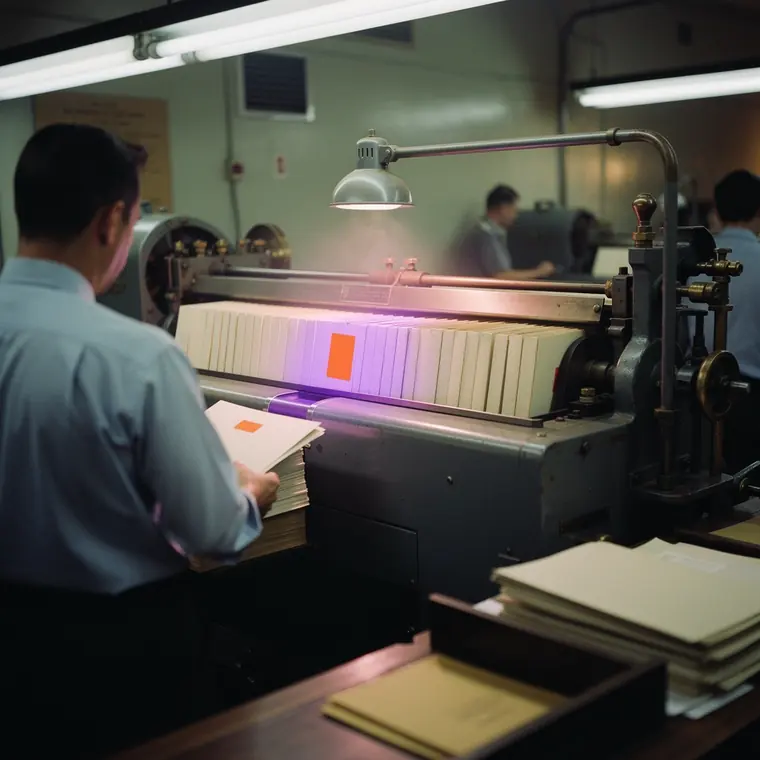
An envelope facing and cancelling machine of 1963 in the cancelling room of a main post office in Dayton in Ohio, a waist-high machine of grey sheet steel two metres long, along its top a narrow channel in which envelopes travel upright one behind another, seen edge-on as a row of pale paper edges, above the channel a small shielded lamp casting a patch of violet light, inside that patch on one envelope a small rectangle glowing orange-red under violet light, two centimetres wide, at the feed end a postal clerk seen from behind in a pale blue shirt with an armful of envelopes, dim even light from fluorescent tubes overhead.
- What it was used for
- The facer-canceler faced letters and cancelled them: it looked for the stamp, turned the letter so that all stamps lay the same way, and cancelled them. The earliest types found the stamp by optical contrast; the National Postal Museum gives a rejection rate of 12 to 14 percent for this, because printing on the envelope or insufficient contrast could deceive the detection device. The machine fed stacked letters at up to 500 per minute; 6 workers could cancel about 27,000 letters an hour with them, where ten-man crews had previously managed about 16,000. The same source gives the initial price as 18,000 dollars and maintenance at about 7,000 dollars a year.
- What was new
- What was new in 1963 was not the machine but the stamp: it was printed with a luminescent additive so the device could find it under ultraviolet light instead of guessing by contrast. Mystic Stamp dates the experiment to 1 August 1963 in Dayton, Ohio, and names C64 as the test stamp, listing the tagged version as C64a. The National Postal Museum writes that the tagged stamp was hit by ultraviolet light produced by the NCR Mark II, and gives for the earlier contrast-based Mark II about 16.4 percent of letters bypassing uncancelled and 3.4 percent stacking errors, roughly 20 percent in all; with ultraviolet, over 98 percent efficiency was reached. The barb is the maker: the postal service names Pitney-Bowes for the first volume order in 1959 of 75 Mark II machines, while the museum names NCR for the ultraviolet type.