The Enfield Cash Machine
1967 · Voucher-Operated Cash Dispenser · Work 753 of 1,871
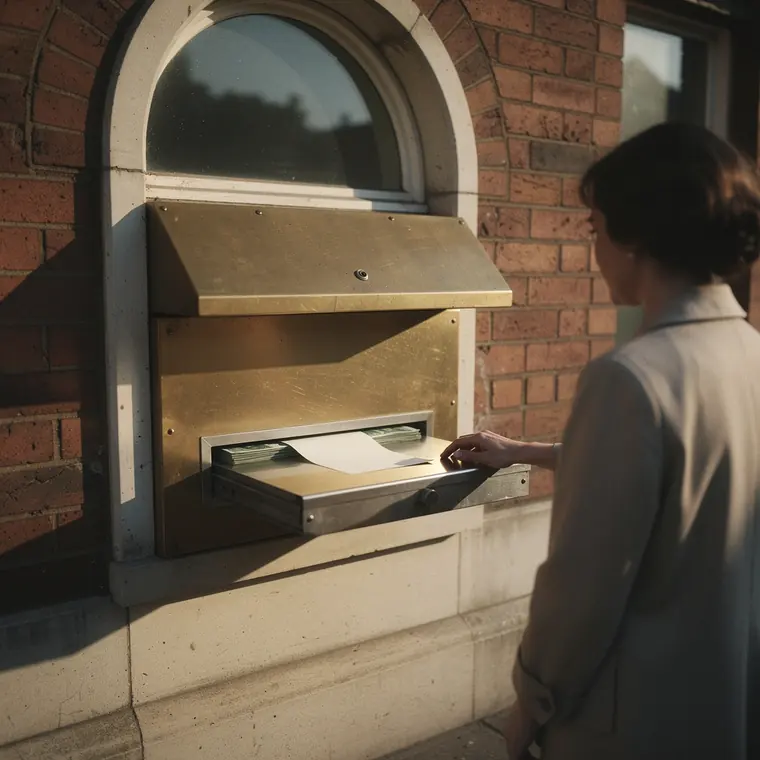
A cash dispensing machine of 1967 set into the street front of a bank building in a suburb in north London on a summer morning, a flat panel of plain brushed metal one metre wide with a small projecting canopy above it, in the pale dressed-stone base beneath a tall round-arched window, red brick above, in the panel a narrow steel drawer pulled half open with a slip of pale paper lying flat inside, beside it a thin bundle of green paper money seen edge-on in a narrow slot, a woman seen from behind in a light summer coat, her hand on the drawer, slanting morning sunlight from the left.
- What it was used for
- On 27 June 1967 Barclays put a cash dispenser into service in Enfield. The bank's own archive writes: "On 27 June 1967 Barclays in Enfield became home to the world's first cash machine." On that account the customer inserted a special paper voucher and keyed a personal code number, "initially 6 digits rather than 4"; the machine was designed to dispense 10 pounds against the voucher. It was developed jointly by De La Rue Instruments and the bank's Management Services Department; initially 6 machines were installed at selected branches. The purpose was cash outside counter hours, without a teller.
- What was new
- What was new was that a machine paid out cash after checking the customer itself — voucher plus secret number instead of a signature and a teller's eye. Enfield was not alone for long: the ATM Industry Association also calls Enfield the world's first automated cash dispenser, but records that two other independent machines were deployed in 1967 — one engineered by Chubb for the Westminster Bank in London, and the Swedish Bankomat in Uppsala. And the start was small: 6 machines.
What the sources leave open: Accounts differ on the length of the code: Barclays' former archive page gave an initial 6 digits, Guinness World Records 4; Barclays' current archivist thinks it was 4, with some debate over 6. Guinness describes the vouchers as paper cheques containing traces of carbon-14.