The Stepped Lens
1823 · Stepped Ring Lens Optic · Work 770 of 1,871
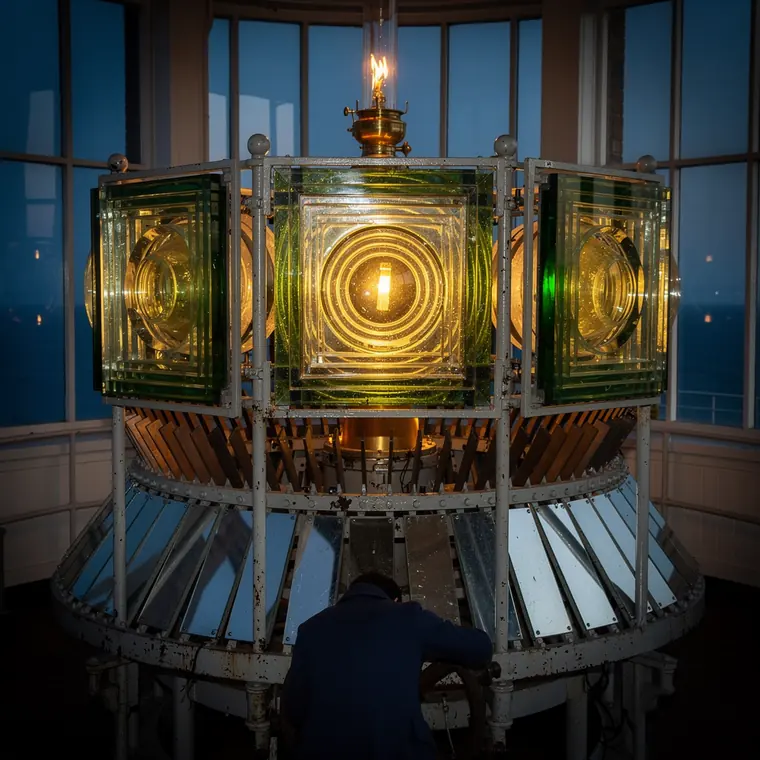
The octagonal lens drum of a lighthouse of 1823 in the lantern room on the French Atlantic coast at dusk, eight square glass panels of about seventy-five centimetres in the drum, each panel concentric stepped glass rings around a central disc, the glass faintly green, the panels held in a framework of upright iron bars painted pale grey, in the centre a brass oil lamp with a tall glass chimney, below the drum rows of tilted metal mirror slats, a keeper seen from behind in blue wool turning a crank at the base, deep blue dusk through the glazing bars of the lantern, the scene lit by the lamp alone.
- What it was used for
- The stepped lens gathers the light of a lamp in a lighthouse into a beam. Fresnel assembled it from separate ring pieces in a metal frame instead of grinding one large block of glass - which saved glass and weight at the top of the tower. In July 1823, according to the Cordouan lighthouse site, he installed his first lens there: an octagonal drum with 8 stepped lenses, a ring of metal mirrors below it, 8 smaller lenses above, and in the centre a lamp with 5 concentric wicks. The same tower had already tried the mirror route: the rotating apparatus of Borda and Lenoir, brought into service on 29 August 1790 with 12 copper parabolic reflectors each about 90 cm across, is called by the same site a near-total failure - visible only at 6 to 7 leagues, that is 23 to 27 km.
- What was new
- The stepped lens was thought out before it was built. Thomas A. Tag, in The Keeper's Log (Spring 2004), cites Buffon in 1748, who proposed a burning lens ground in steps from a single block of glass (the Abbé Rochon built such a lens 12 to 15 inches across in 1780), Condorcet in 1788 with one-piece rings, and Brewster in 1812 in the Edinburgh Encyclopedia with a polyzonal burning lens built from ring segments. Brewster claimed priority for the lighthouse lens in 1823 and 1827; Tag records that the Stevensons refuted this, and judges that Brewster deserves credit for the stepped lens made of ring pieces but Fresnel for the lighthouse lens as built - Brewster's lens was intended for burning and was never made. Fresnel's first paper dates from 1819, his memoir on a new system of lighthouse illumination from 29 July 1822.